Ultimate FPV Motors Guide for Better Power and Control
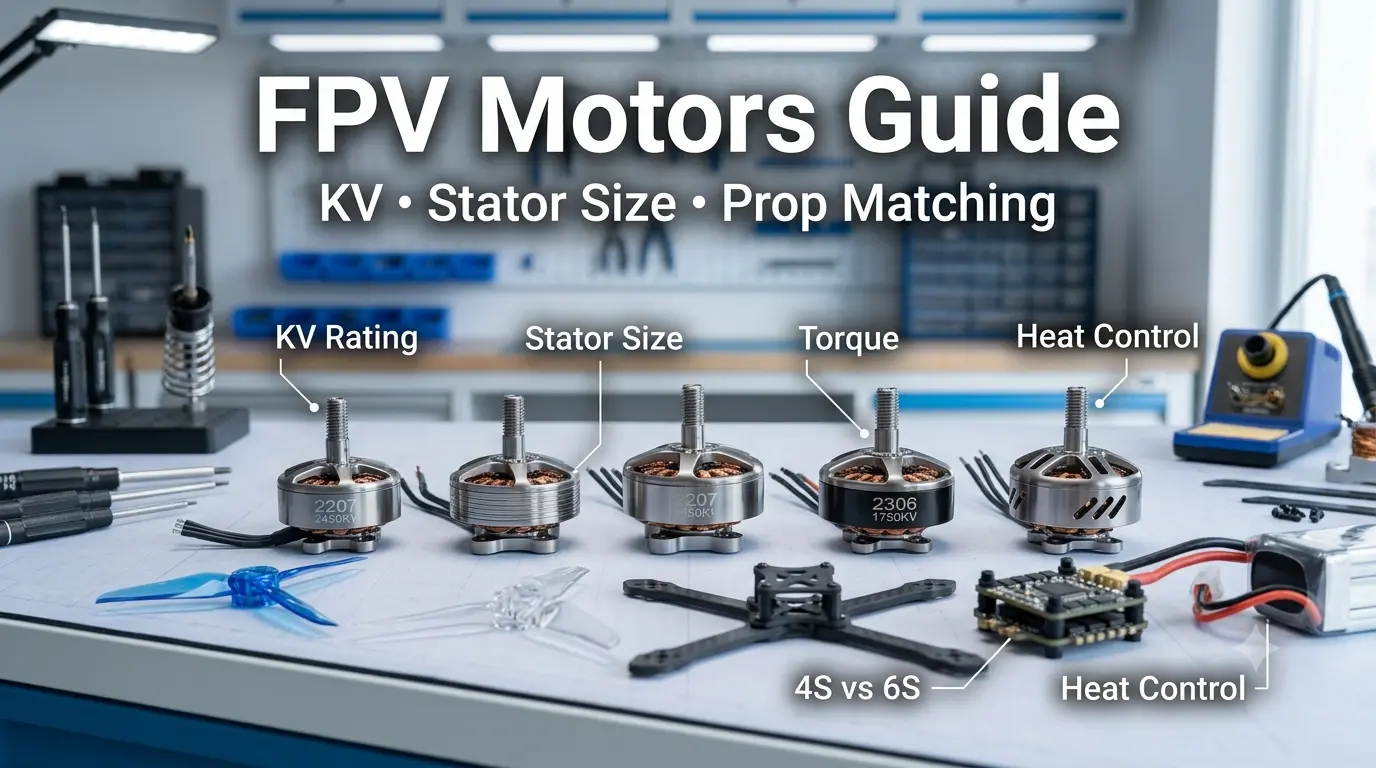
FPV Motors: KV, Stator Size, and Prop Matching
FPV motors convert battery power into propeller rotation, and their KV rating, stator size, torque output, and voltage match decide how a quad accelerates, recovers, heats, and uses current. A motor is not chosen by KV alone because frame size, prop size, battery voltage, ESC rating, aircraft weight, and flying style all affect motor load.
This guide focuses only on FPV motor selection and motor-to-system matching. Frame-class decisions belong in the previous guide on 5-inch FPV frames, while blade shape and pitch behavior belong in the next guide on FPV propellers.
How FPV Motors Work
An FPV motor is a brushless outrunner motor. The stator stays fixed, and the bell rotates around it with magnets attached inside the motor bell. The ESC sends timed electrical pulses through the motor windings, creating magnetic fields that spin the bell and the propeller.
Most FPV quads use outrunner motors because they produce strong torque in a small, lightweight package. That torque matters because propellers create air resistance, and the motor must change speed quickly during throttle punches, flips, rolls, dives, and recoveries.
A motor should be judged by these factors:
- KV rating: Theoretical RPM per volt with no prop load.
- Stator size: Motor width and height that affect torque.
- Voltage match: 4S, 6S, or other battery support.
- Prop load: Diameter, pitch, blade count, and weight.
- Current draw: Load placed on the ESC and battery.
- Heat control: Motor temperature under real flight demand.
- Weight: Mass added at the arm ends.
Motor KV Rating
Motor KV means theoretical no-load revolutions per minute per volt. A 1750KV motor would calculate to 1,750 RPM for every volt applied before propeller load, air resistance, friction, and electrical losses.
A 1750KV motor on 6S nominal voltage, or 22.2V, calculates to about 38,850 RPM with no propeller. A 2450KV motor on 4S nominal voltage, or 14.8V, calculates to about 36,260 RPM with no propeller. These numbers are not real flight RPM, but they explain why lower-KV 6S motors and higher-KV 4S motors can produce similar prop speed.
High KV Motors
High KV motors spin faster per volt. They can feel sharp and responsive when matched with the correct propeller and battery voltage.
The risk is current draw. A high KV motor paired with a heavy prop or high voltage can pull excessive current, heat the windings, stress the ESC, and reduce battery efficiency. High KV is not automatically faster if the motor cannot handle the prop load cleanly.
Low KV Motors
Low KV motors spin slower per volt but can work better with higher voltage or larger props. A lower KV motor on 6S can produce strong power with less current than an equivalent high-KV 4S setup in many 5-inch builds.
The risk is weak response if KV is too low for the voltage and propeller. A low KV motor on a small prop may feel dull because the propeller cannot reach enough speed for quick thrust changes.
Stator Size
Motor size is usually written as 4 digits, such as 2207, 2306, 2407, or 2806.5. The first 2 digits describe stator width in millimeters. The last digits describe stator height in millimeters.
A 2207 motor has a 22 mm stator width and 7 mm stator height. A 2306 motor has a 23 mm stator width and 6 mm stator height. A 2806.5 motor has a 28 mm stator width and 6.5 mm stator height.
Stator Width
Stator width affects torque surface area and motor character. Wider motors can produce strong torque and good prop control, but they may add weight and current demand.
A wider stator can help when the prop needs more control, especially on heavier quads or larger props. The motor still has to match the frame and battery system because extra motor weight at the arms changes handling.
Stator Height
Stator height also affects torque and power capacity. A taller stator can produce more torque and handle more load, but it usually weighs more.
Motor height matters in high-load builds. A motor that is too small for the prop can heat quickly because it works near its limit. A motor that is too large for the aircraft can make the quad heavier without improving real flight performance.
Motor Size by Frame Class
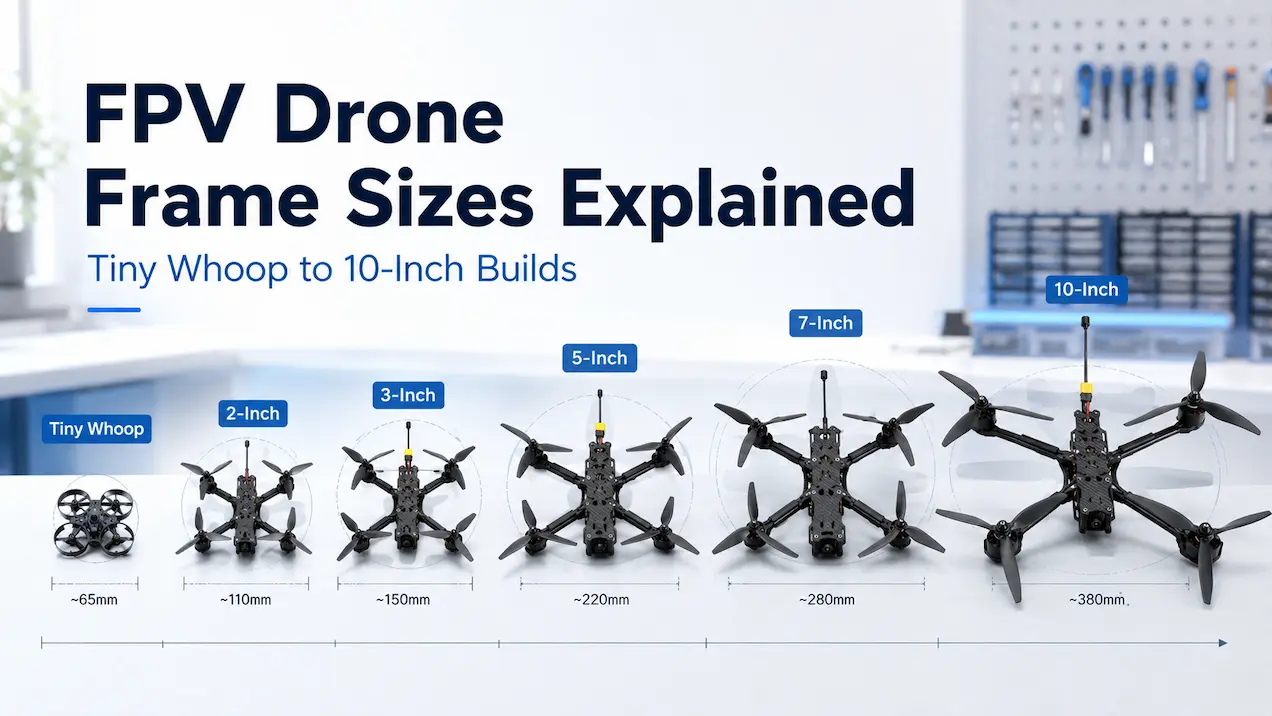
Motor size should match propeller class, not only pilot preference. A motor built for a tiny whoop cannot drive a 5-inch prop. A motor built for a 7-inch cruiser is usually too heavy for a 3-inch micro.
Common pairings include:
| Frame Class | Common Motor Range | Reason |
|---|---|---|
| Tiny whoop | 0802–1102 | Light weight and small props |
| 2-inch | 1103–1303 | Compact outdoor or ducted use |
| 2.5-inch | 1204–1404 | Lightweight micro thrust |
| 3-inch | 1404–1606 | Better outdoor control |
| 3.5-inch | 1604–2004 | Stronger micro performance |
| 5-inch | 2207–2306 | Freestyle and racing balance |
| 6-inch | 2407–2507 | More prop load and cruising |
| 7-inch | 2507–2807 | Efficient larger-prop control |
| 8-inch+ | 2806.5 and larger | Payload or endurance layouts |
These are common ranges, not fixed rules. Aircraft weight, prop style, voltage, and flight goal can shift the correct motor choice.
4S vs 6S Motor Matching
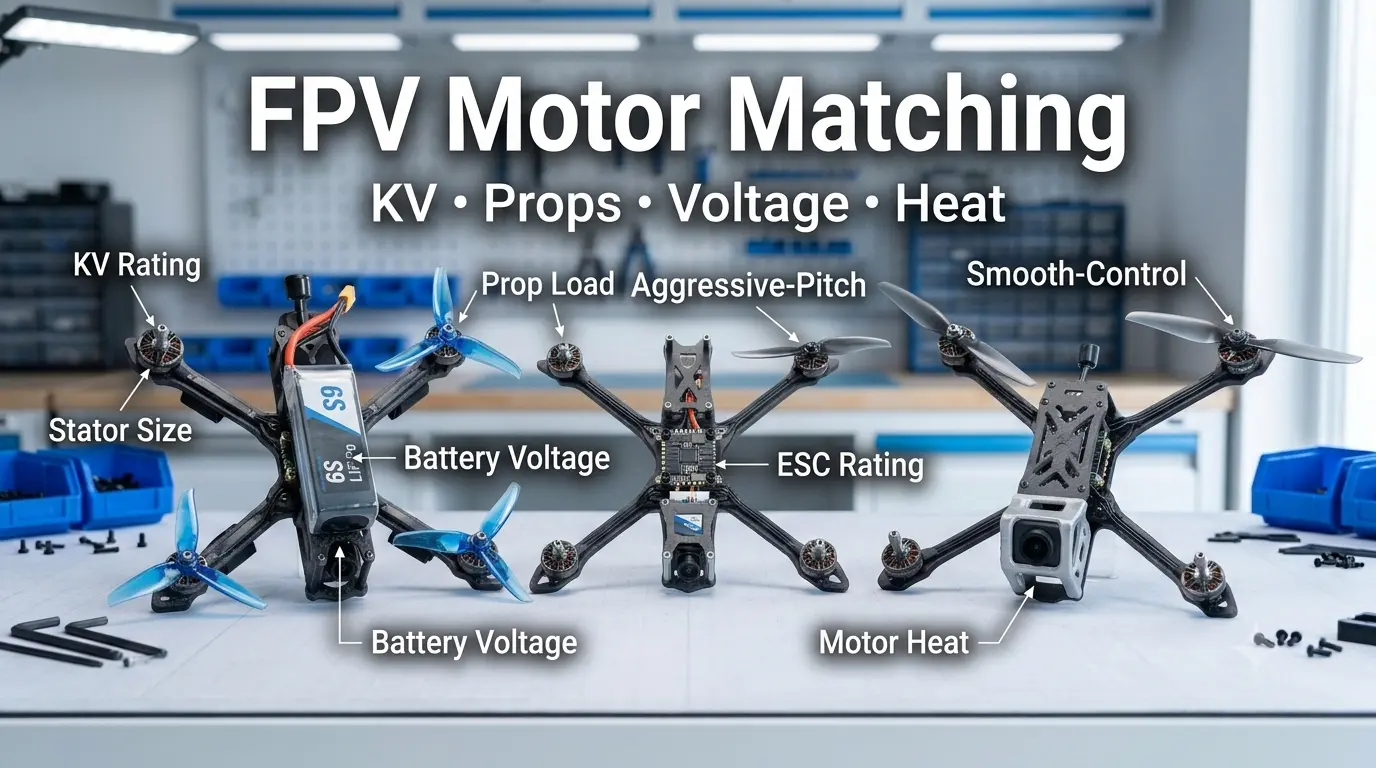
Battery voltage changes motor speed and current behavior. A 4S LiPo has 14.8V nominal voltage. A 6S LiPo has 22.2V nominal voltage. Fully charged voltage is 4.2V per cell, so 4S charges to 16.8V and 6S charges to 25.2V.
A 6S setup usually uses lower KV motors than a 4S setup because the voltage is higher. The goal is not simply more RPM. The goal is useful prop speed with controlled current draw and manageable heat.
4S Motor Setups
A 4S 5-inch freestyle build commonly uses higher KV motors than a 6S build. The higher KV compensates for lower voltage.
4S setups can feel punchy, but they may draw more current for similar output compared with a well-matched 6S setup. Higher current can increase voltage sag, heat, and battery stress under aggressive throttle use.
6S Motor Setups
A 6S 5-inch build commonly uses lower KV motors. The higher voltage allows similar prop speed with less current for many setups.
6S is popular because voltage sag can feel lower under load when the battery and motor are correctly matched. The build still needs 6S-rated ESCs, flight controller input support, capacitor voltage margin, and VTX power planning.
Motor Load From Prop Choice
Motor load increases when a propeller has more diameter, pitch, blade area, or blade count. This article covers only the motor-side effect of that load. Detailed blade shape, pitch behavior, material choice, and propeller selection belong in the next guide on FPV propellers.
A larger or higher-pitch prop creates more resistance. The motor must overcome that resistance while staying within a safe temperature and current range. If the prop is too aggressive for the motor, the quad may feel powerful for a few seconds, then sag, heat, or damage parts.
Diameter Load
Propeller diameter changes how much air the motor has to move. Larger props usually need more torque. A 7-inch prop places more load on a motor than a 5-inch prop when pitch and blade count are similar.
This is why larger frames usually use larger stator motors. The motor needs enough torque to control the prop during acceleration, braking, and direction changes.
Pitch Load
Higher pitch usually increases thrust potential and current draw. A high-pitch prop on a high-KV motor can overload the ESC during full-throttle moves.
The motor does not know the prop size label. It only sees load. If the prop resists rotation too much, current rises and heat builds.
Motor Torque and Control Feel
Torque is the motor’s ability to turn the propeller against resistance. More torque can improve prop control, throttle response, and recovery during hard moves.
Torque is affected by stator size, magnet strength, winding design, air gap, motor construction, and current available from the ESC and battery. KV alone does not describe torque.
Low-End Control
Low-end control matters during slow freestyle, proximity flying, and smooth cinematic movement. A motor that responds predictably at low throttle helps the pilot manage altitude and small corrections.
Too much motor for a light build can make throttle feel touchy. Too little motor for a heavy build can make the quad feel delayed and soft.
High-Throttle Recovery
High-throttle recovery matters during dives, punch-outs, split-S exits, and prop wash recovery. The motor must accelerate the prop quickly without desync, overheating, or pulling more current than the ESC can handle.
A heavy quad with weak motors may need more throttle to recover, which reduces flight time and increases battery sag.
Motor Weight and Arm-End Mass
Motor weight sits at the end of the arms, so it affects rotational inertia more than central weight. Heavier motors can make a quad feel slower during flips, rolls, and quick direction changes.
A stronger motor can be worth the weight when the aircraft carries a camera, larger battery, or heavier frame. It becomes a problem when the extra torque is not needed.
Lightweight Builds
Lightweight builds benefit from smaller motors because lower arm-end mass improves responsiveness. This matters for racing, micro builds, and efficiency-focused aircraft.
A motor that is too small will still fail the build if it overheats or cannot control the prop. The goal is the lightest motor that handles the actual prop load safely.
Heavy Builds
Heavier freestyle, cinematic, and long-range builds may need larger motors because the aircraft carries more mass and prop load. The motor must recover from throttle changes without excessive heat.
Oversizing still has a limit. A motor that is far heavier than needed can reduce agility and shorten flight time.
Motor Heat
Motor heat is one of the clearest signs of mismatch. Motors become hot when they work too hard, when props are too aggressive, when tuning is noisy, when bearings are damaged, or when ESC settings are wrong.
A motor can be warm after normal flight. It should not be too hot to touch briefly after a typical pack. Extreme heat can damage magnets, windings, bearings, and motor enamel.
Common Heat Causes
Motor heat can come from:
- Too much prop load: Diameter, pitch, or blade count is too aggressive.
- Too high KV: Motor speed demand is too high for the voltage and prop.
- Heavy aircraft: Motors work harder to lift excess weight.
- Bad tune: Noise and oscillation force the motors to overcorrect.
- Bent props: Vibration increases motor work.
- Damaged bearings: Friction and vibration rise.
- Wrong ESC settings: Timing or firmware behavior can increase stress.
Heat should be diagnosed by checking the whole mechanical and electrical system, not just replacing motors.
Motor Durability
FPV motors take direct crash impacts because they sit at the outer ends of the frame. Durability depends on bell strength, shaft design, bearing quality, magnet retention, base thickness, and wire protection.
A motor can survive many crashes but still develop rough bearings, bent shafts, loose magnets, or damaged windings.
Bell and Shaft Damage
A bent motor bell can create vibration, reduce efficiency, and cause the motor to rub. A bent shaft can make the prop spin off-axis.
Small vibration at the motor can become visible in gyro data and camera footage. If a motor sounds rough or feels notchy by hand, it should be inspected before the next flight.
Motor Wires
Motor wires run from the motor to the ESC pads. They should be protected from prop strikes, sharp carbon edges, and arm impacts.
A cut motor wire can short phases, damage the ESC, or cause one motor to stop. Clean wire routing matters on every build, especially crash-heavy freestyle quads.
Choosing Motors by Flying Style
Motor selection should match the flight goal. The same frame can feel different with motor changes because torque, weight, KV, and prop load affect response.
| Flying Style | Motor Priority | Reason |
| Freestyle | Torque and durability | Recovery, prop control, and crash survival |
| Racing | Low weight and fast response | Acceleration and gate corrections |
| Cinematic | Smooth control and low vibration | Cleaner footage and predictable movement |
| Long-range | Efficiency and low current draw | Longer cruising and lower heat |
| Micro flying | Low weight | Small frames punish extra grams |
For broader navigation across drones, frames, and power gear, OmnyxTech product categories keep the main site paths connected without turning this motor guide into a product page.
Common FPV Motor Mistakes
Motor mistakes usually happen when builders choose by KV number, popularity, or maximum thrust instead of system match.
Common mistakes include:
- Choosing KV alone: KV does not show torque, efficiency, or heat behavior.
- Overmotorizing micros: Heavy motors ruin small-frame response.
- Undermotorizing heavy builds: Weak motors run hot and recover poorly.
- Ignoring voltage: 4S and 6S setups need different KV ranges.
- Overloading props: Large or high-pitch props increase current and heat.
- Ignoring ESC rating: Motors can demand more current than the ESC can handle.
- Skipping temperature checks: Hot motors reveal mismatch or mechanical issues.
- Using damaged props: Bent props can make good motors run hot.
- Ignoring motor wires: Exposed wires can be cut by props or carbon edges.
- Copying builds blindly: A motor that works on one quad may fail on a heavier build.
FPV Motor Selection Checklist
Use this checklist before choosing motors:
- Frame class: Match motor size to propeller class.
- Battery voltage: Choose KV for 4S, 6S, or the intended cell count.
- Prop load: Check diameter, pitch, and blade count.
- Aircraft weight: Heavier quads need more torque.
- ESC current: ESC rating must handle expected motor draw.
- Flying style: Freestyle, racing, cinematic, or long-range use.
- Motor weight: Avoid unnecessary arm-end mass.
- Cooling: Motors need airflow and safe temperature behavior.
- Durability: Bell, shaft, bearings, and wires must suit crash risk.
- Replacement access: Motors should be easy to replace after impact.
FAQ
What does KV mean on FPV motors?
KV means theoretical no-load RPM per volt. A 1750KV motor calculates to 1,750 RPM for each volt before propeller load. KV helps match motor speed to battery voltage and prop size, but it does not directly measure torque, efficiency, durability, or real in-flight RPM.
Are lower KV motors better for 6S?
Lower KV motors are usually used on 6S because 6S has higher voltage than 4S. The lower KV keeps prop speed in a usable range while controlling current draw and heat. A 6S build still needs compatible ESCs, voltage-rated electronics, and a prop load that the motor can handle.
What motor size is common for 5-inch FPV drones?
Many 5-inch freestyle and racing builds use 2207 or 2306 motors. These sizes balance torque, weight, and prop control for 5-inch props. The better choice depends on aircraft weight, prop style, battery voltage, flying style, and desired throttle feel.
Why do FPV motors get hot?
FPV motors get hot from excessive prop load, high KV on too much voltage, heavy aircraft weight, bad tuning, bent props, damaged bearings, or ESC settings. Heat is a symptom, not a diagnosis by itself. Check props, screws, bearings, motor wires, tune quality, and current demand before replacing parts.
Can I use bigger motors for more power?
Bigger motors can provide more torque, but they also add weight at the arm ends. Extra motor weight can reduce agility and flight time if the build does not need the torque. The right motor is the one that controls the prop safely without overheating or adding unnecessary mass.