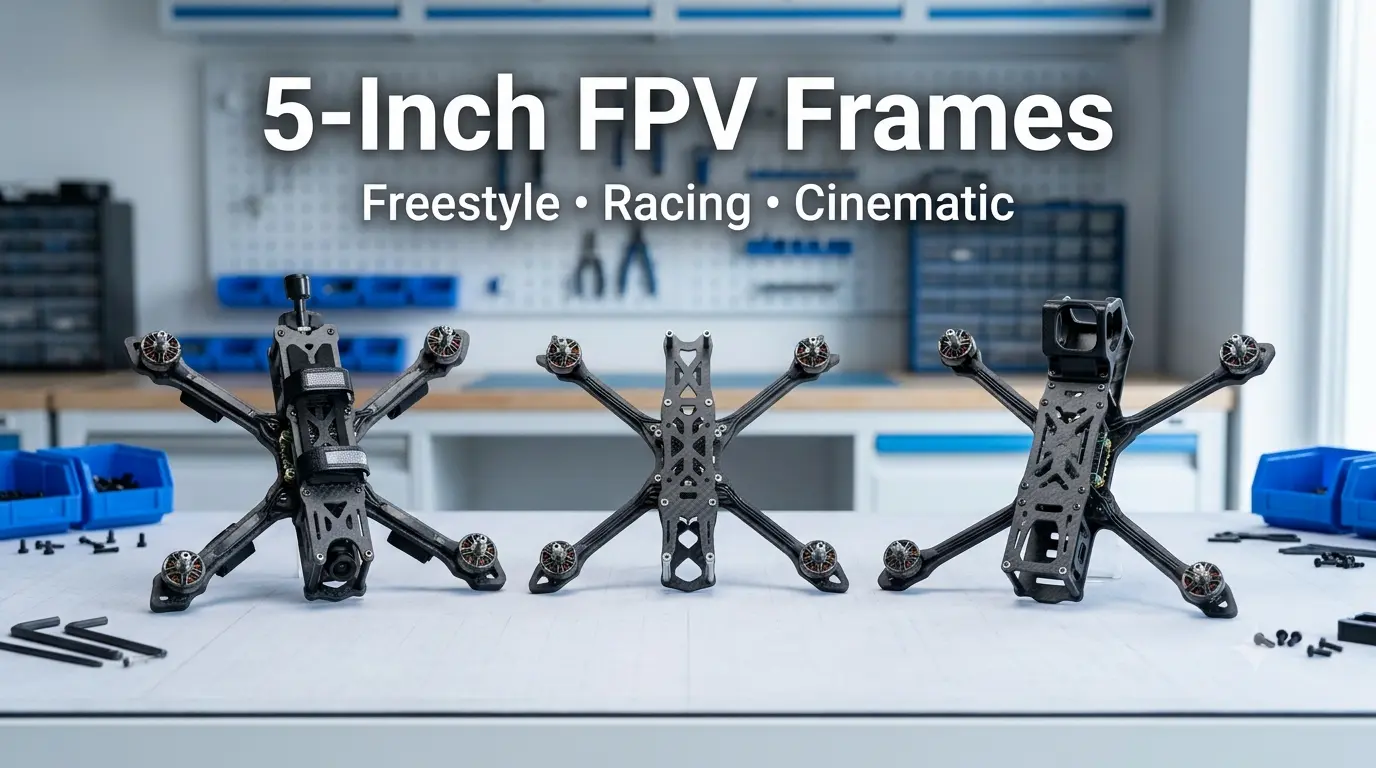
Ultimate 5-Inch FPV Frames Guide for Better Flying
5-Inch FPV Frames: Freestyle, Racing, Cinematic
5-inch FPV frames are the standard outdoor platform for freestyle, racing, and fast cinematic flying because they balance prop authority, repairability, electronics space, and crash durability. The frame choice controls how the quad protects its camera, holds the flight stack, clears propellers, mounts the battery, routes antennas, and survives repeated impacts.
This guide focuses only on the 5-inch frame class. Material behavior belongs in the previous guide on FPV frame materials, while motor selection belongs in the next guide on FPV motors.
Why 5-Inch Frames Became the Outdoor Standard
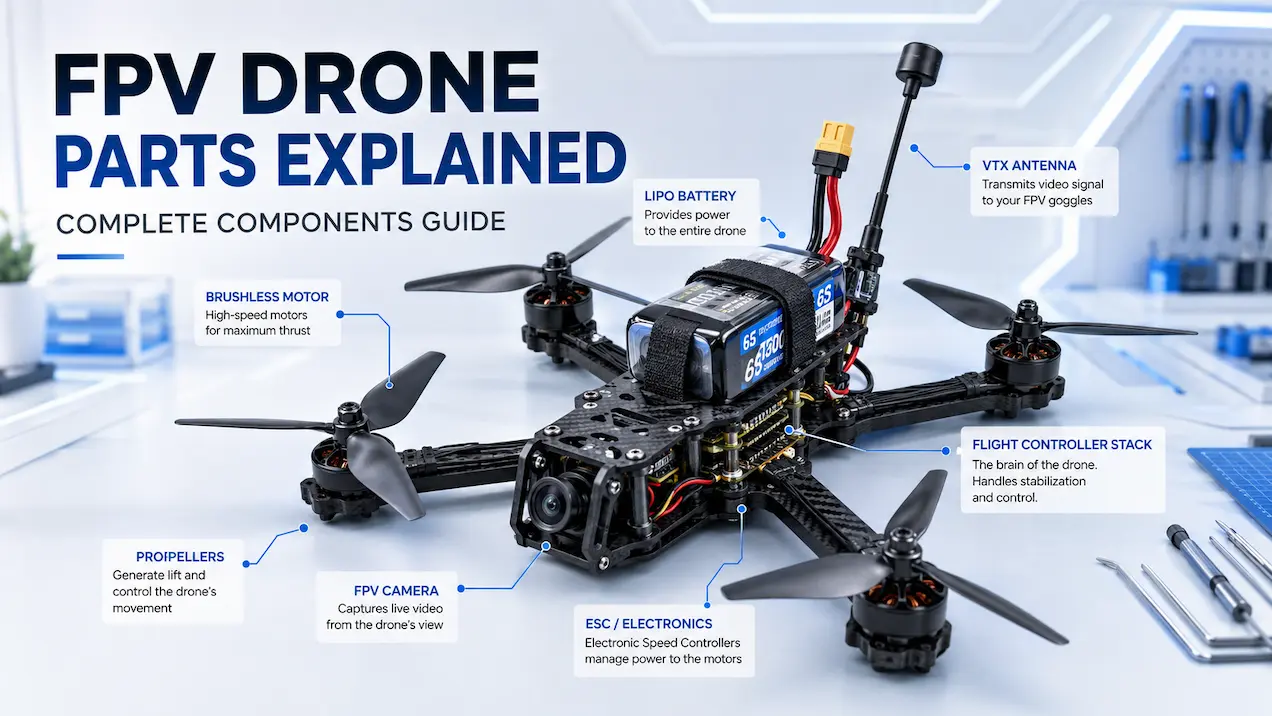
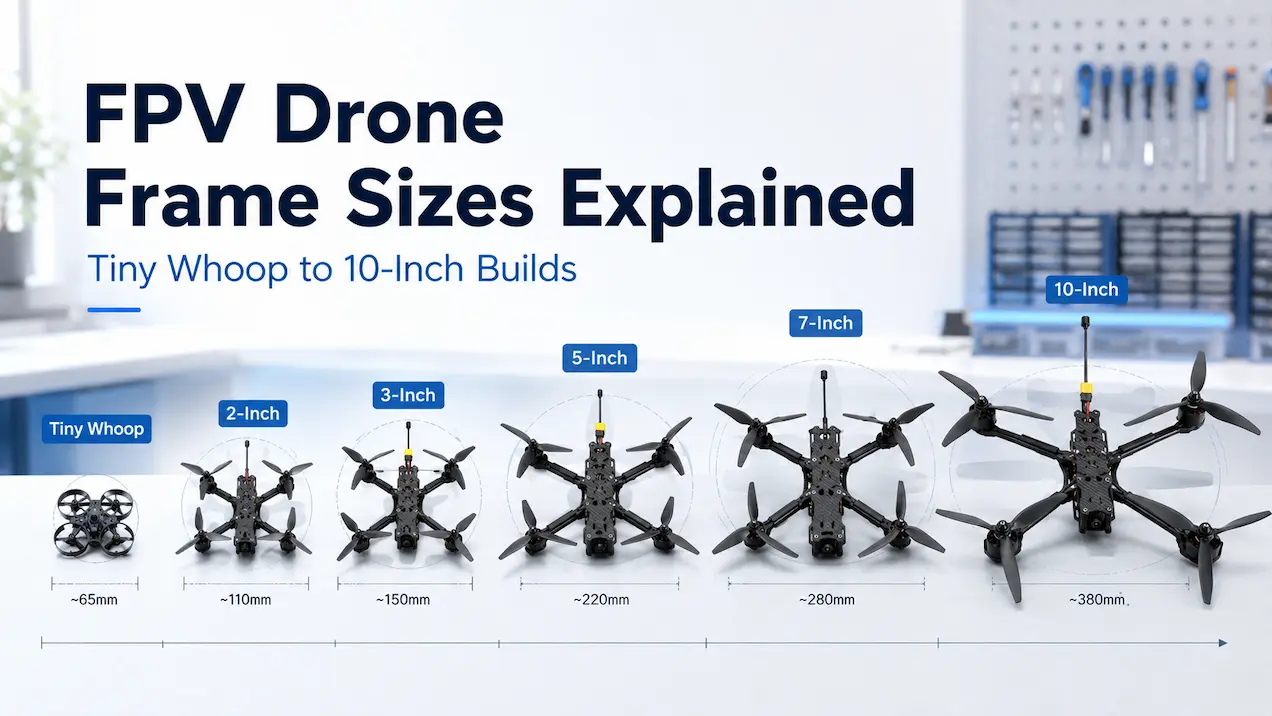
A 5-inch frame gives enough propeller area for strong outdoor thrust without becoming as large or slow-reacting as a 7-inch cruising platform. Most 5-inch builds use carbon fiber arms, a central electronics stack, exposed props, and a top-mounted battery.
The class is common because it supports several outdoor flight goals:
- Freestyle: Strong response, repairable arms, and protected cameras.
- Racing: Low weight, stiff geometry, fast repair, and clean forward tracking.
- Cinematic flying: Stable outdoor movement, HD camera support, and prop-clear layout options.
- Practice: Wide parts availability and predictable handling.
- Repair: Replaceable arms, common hardware, and broad aftermarket support.
A 5-inch frame is not the best option for small indoor rooms, quiet backyard practice, or beginner-only micro training. It needs space, safe distance, and a pilot who can manage speed and impact risk.
Core 5-Inch Frame Requirements
A 5-inch frame must provide safe prop clearance, strong arm support, secure stack mounting, protected camera placement, reliable battery retention, and clean antenna routing. These requirements matter more than appearance.
A frame that looks clean but leaves the camera exposed, traps heat around electronics, or lets arms shift after a crash will create more problems than a slightly heavier frame with better structure.
Prop Clearance
A 5-inch frame must clear 5-inch or 5.1-inch propellers without the blades touching arms, ducts, battery straps, camera mounts, or wires. Clearance should remain safe when props flex under load.
Too little clearance creates 3 problems:
- Blade strikes: Props can hit the frame during throttle changes.
- Vibration: Flexing props near carbon can increase noise.
- Crash damage: Bent props may cut wires or battery straps.
Prop clearance should be checked with the actual prop size, not only the advertised frame class.
Stack Space
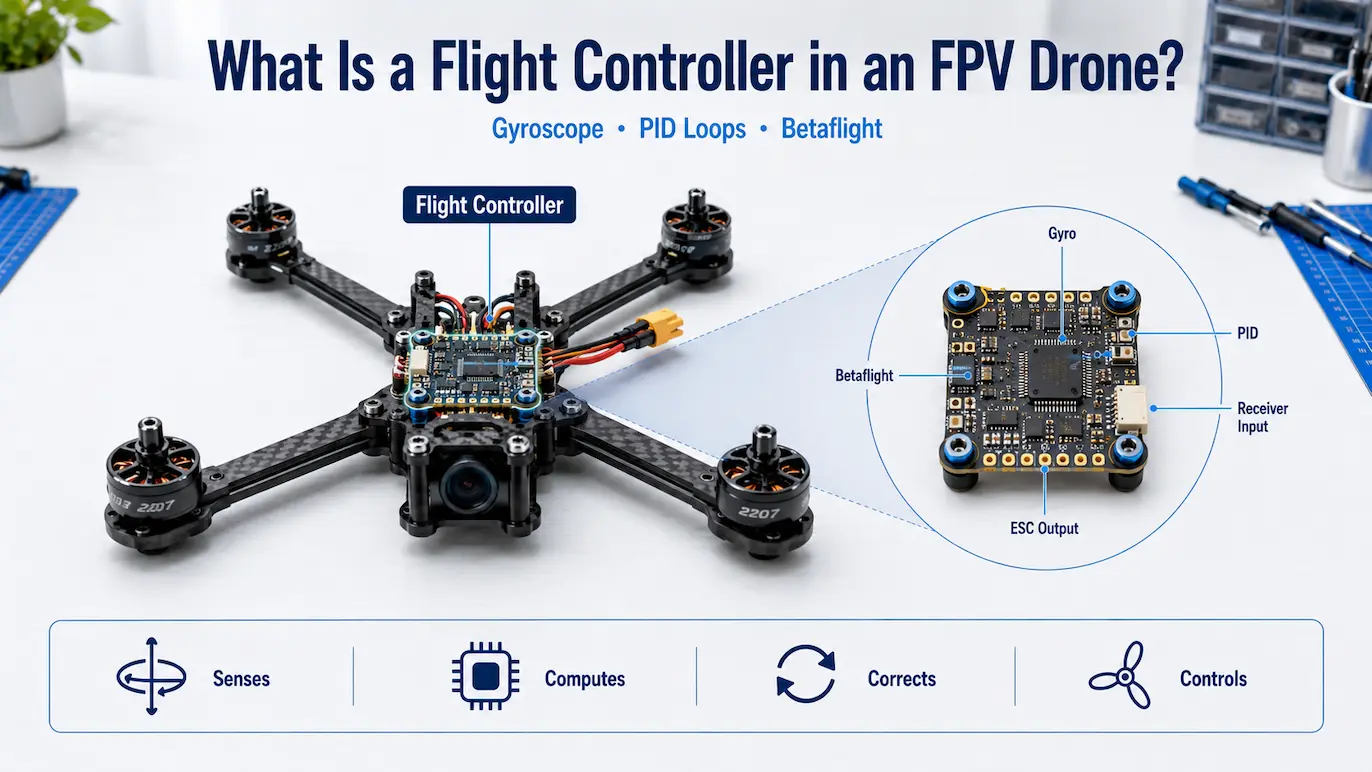
Most 5-inch frames support 30.5×30.5 mm, 20×20 mm, or both stack patterns. Stack space affects the ESC, flight controller, receiver, VTX, capacitor, and wiring route.
A tight body can make the build harder to service. A roomy body makes wiring easier but can add weight and reduce compactness. The best 5-inch frame gives enough space for clean electronics without becoming oversized.
Battery Mounting
5-inch frames usually carry the battery on top of the frame. Some use bottom-mounted batteries, but top mounting is more common for freestyle and racing.
A good battery area needs a flat pad, strong strap route, enough length for common 4S or 6S packs, and clearance from prop arcs. Battery ejection is common in hard crashes when the strap path is weak or the battery pad has poor grip.
Freestyle 5-Inch Frames
Freestyle 5-inch frames are built for crashes, tricks, camera protection, and repeated repairs. They usually use thicker arms, stronger front ends, replaceable arm designs, and enough body space for protected electronics.
Freestyle flying involves dives, flips, rolls, gaps, wall rides, and ground proximity. These moves create repeated impacts from concrete, trees, dirt, rails, and building edges. A freestyle frame should survive more than one clean hit.
Freestyle Layout Priorities
A freestyle frame should prioritize:
- Replaceable arms: One broken arm should not require a full rebuild.
- Camera protection: Side plates or standoffs should shield the lens.
- Strong front end: Nose impacts are common during failed gaps.
- Stack protection: Electronics should sit inside the body profile.
- Battery retention: The battery should stay mounted during tumbles.
- Arm stiffness: Arms should resist flex during hard throttle changes.
True-X and hybrid-X layouts are common because they provide balanced roll and pitch feel. Some freestyle pilots use deadcat layouts when cleaner HD footage matters more than perfectly symmetrical motor geometry.
Freestyle Frame Mistakes
A common freestyle mistake is choosing a lightweight racing frame for crash-heavy flying. The quad may feel sharp at first, but thin arms, exposed cameras, and weak plates increase repair frequency.
Another mistake is overbuilding the frame. Very thick arms, heavy TPU, oversized mounts, and unnecessary braces can make the quad feel slower and reduce flight time. A freestyle frame should be durable, not unnecessarily heavy.
Racing 5-Inch Frames
Racing 5-inch frames focus on stiffness, low weight, fast repair, and forward-flight tracking. Racing frames often use stretched-X geometry, minimal plates, clean stack placement, and light camera protection.
Race courses require quick acceleration, sharp gate alignment, fast turns, and predictable recovery after corrections. A frame that flexes, shifts arms, or adds unnecessary weight can reduce lap consistency.
Racing Layout Priorities
A racing frame should prioritize:
- Low weight: Less mass improves acceleration and braking.
- Stiff arms: Cleaner response during rapid stick input.
- Fast access: Arms and props should be easy to replace.
- Low profile: Less exposed material reduces drag and impact area.
- Camera angle range: Higher tilt supports faster forward flight.
- Clean antenna placement: Video and radio links should stay clear of carbon blockage.
Stretched-X geometry can help racing quads feel more stable in fast forward movement. The tradeoff is less symmetrical feel than true-X during freestyle-style tricks.
Racing Frame Mistakes
A common racing mistake is choosing a frame only by weight. A very light frame that flexes under motor load can create inconsistent handling. A slightly heavier but stiffer frame may produce better lap consistency.
Another mistake is poor repair access. A racing frame should allow quick arm replacement, camera adjustment, and stack inspection between heats. A complicated frame can waste time during field repairs.
Cinematic 5-Inch Frames
Cinematic 5-inch frames support fast outdoor movement, HD camera mounting, clean camera view, and stable flight lines. They are not the same as cinewhoop frames because they usually use open props and require more space.
A 5-inch cinematic frame works well for outdoor fly-throughs, landscape movement, vehicle following, and high-speed reveal shots. It is not the best frame for tight indoor flights around people or fragile objects.
Cinematic Layout Priorities
A cinematic 5-inch frame should prioritize:
- HD camera support: The frame must hold a camera mount securely.
- Low vibration: Camera footage suffers when the frame resonates.
- Prop visibility control: Deadcat or wider front layouts can reduce visible props.
- Battery security: Smooth footage still needs crash-safe mounting.
- Stack airflow: Digital video hardware and VTX units need cooling.
- Front protection: Camera impact can ruin a filming session immediately.
Deadcat layouts are common when clean forward footage matters. True-X layouts can still work when prop visibility is acceptable or the HD camera angle avoids the prop arcs.
Cinematic Frame Mistakes
A common mistake is treating a 5-inch cinematic frame like a protected cinewhoop. Open 5-inch props create more risk around people, vehicles, walls, and indoor spaces.
Another mistake is using a soft, flexible frame for smoother footage. Smooth footage comes from a clean mechanical build, balanced props, secure camera mounting, and low vibration. Excessive flex can make the gyro data and HD footage worse.
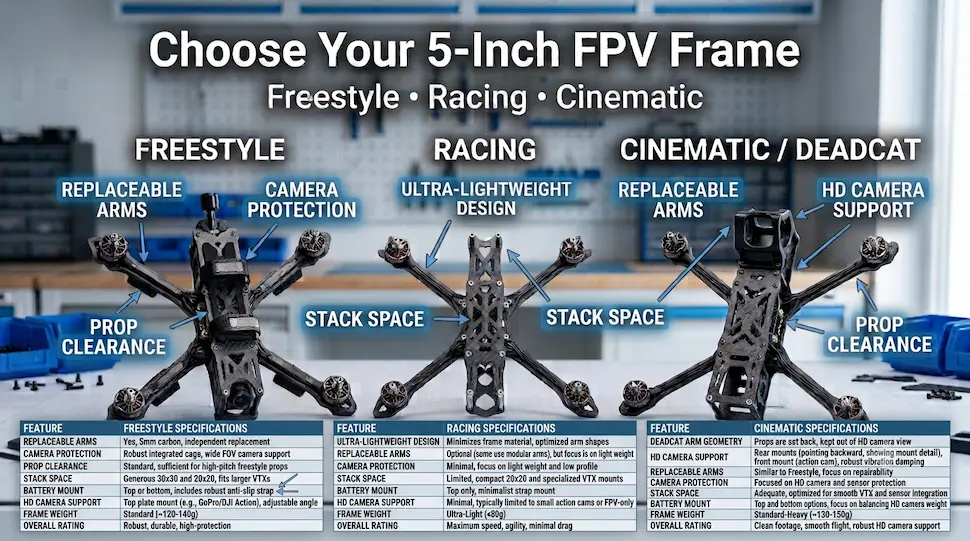
True-X, Stretched-X, and Deadcat in 5-Inch Frames
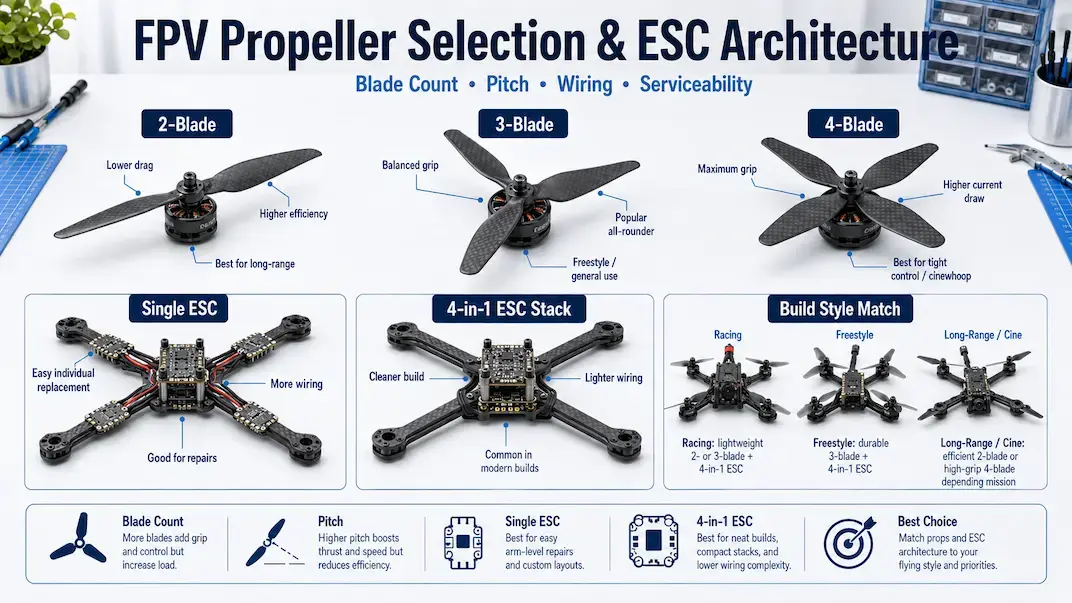
The 5-inch class commonly uses true-X, stretched-X, deadcat, and hybrid layouts. The correct layout depends on the flight goal.
| Layout | Best Fit | Main Tradeoff |
|---|---|---|
| True-X | Freestyle balance | Props may appear in view |
| Stretched-X | Racing and fast lines | Less symmetrical freestyle feel |
| Deadcat | Cleaner cinematic footage | Less even motor geometry |
| Hybrid-X | Mixed freestyle and filming | Depends heavily on exact design |
Layout should match the main use, not the trend. A deadcat frame can make sense for clean footage, but it is not automatically better for freestyle. A stretched-X frame can be fast, but it may not feel as natural for slow technical tricks.
Arm Design and Repairability
Arms decide how a 5-inch frame survives crashes. They carry the motors, absorb impact, and resist bending during throttle changes. Arm thickness, width, cutout shape, screw clamping, and replacement access all matter.
Many freestyle frames use 5 mm or 6 mm arms. Racing frames may use lighter arms when weight matters more than repeated impact survival. Cinematic frames often balance stiffness with vibration control and camera load.
Replaceable Arms
Replaceable arms are usually the safer choice for 5-inch freestyle and cinematic builds because crashes can break one arm without destroying the full bottom plate.
A good replaceable-arm design has enough clamping area to stop arm shift. If the arm can twist after a crash, the motor alignment changes and the quad may fly poorly even if the carbon is not broken.
Arm Shape
Arm shape matters as much as thickness. A wide 5 mm arm with clean load paths can be stronger than a narrow 6 mm arm with sharp cutouts near screw holes.
Avoid frames with aggressive cutouts at high-stress points. Sharp internal corners concentrate stress and can start cracks after repeated impacts.
Camera Protection and View
A 5-inch frame should protect the FPV camera without blocking the view or forcing an awkward camera angle. Camera protection is especially important for freestyle and cinematic flying because front impacts are common.
Good protection includes carbon side plates, front standoffs, TPU bumpers, or recessed camera mounting. Poor protection leaves the lens exposed or lets the camera shift after a crash.
Camera Angle Range
Camera angle affects flight speed and visibility. Freestyle pilots often use moderate tilt. Racing pilots may use higher tilt. Cinematic pilots usually choose the lowest tilt that still supports the shot speed.
A frame should allow angle adjustment without letting the camera touch top plates, side plates, or HD camera mounts.
HD Camera Mounting
A 5-inch frame used for filming should support a secure HD camera mount. Loose mounts create vibration and angle shift. Oversized mounts add weight and increase crash leverage on the top plate.
The mount should hold the camera firmly while keeping the battery strap, antenna, and top plate accessible.
Stack Space, Heat, and Wiring
A 5-inch frame must leave enough room for the stack, receiver, VTX, capacitor, antenna leads, and battery lead. Tight builds can work, but they increase repair time and heat risk.
Airflow matters because ESCs, VTX units, and digital air systems can heat up during setup and flight. A frame that traps electronics under thick plates or large mounts can make cooling worse.
Clean Wiring
Clean wiring reduces prop strikes, electrical shorts, and repair problems. Battery leads should not reach prop arcs. Receiver antennas should not sit flat against carbon. VTX antenna leads should not be pinched between plates.
Sharp carbon edges near wires should be smoothed or protected. A small cut in insulation can create a short during vibration or after a crash.
Service Access
A 5-inch frame should allow access to the USB port, stack screws, camera screws, VTX buttons, antenna connectors, and arm bolts. A frame that requires full teardown for small repairs becomes frustrating after repeated crashes.
Service access matters more in freestyle and racing than in slow cruising because damage happens more often.
Weight Balance
Weight balance affects how a 5-inch quad feels during flips, rolls, dives, and recoveries. A frame can have strong arms and still feel poor if the battery, camera, and stack placement create bad balance.
The center of mass should sit close to the propeller plane and near the center of the frame. A heavy camera mounted far forward or a battery placed too far back can make the quad feel uneven.
Front Weight
Extra front weight can help camera stability in some cinematic setups, but it can also make flips and recoveries feel slower. Freestyle frames should avoid unnecessary front-heavy layouts.
Rear Weight
Rear-heavy layouts can make the quad feel unstable during dives and throttle changes. Rear-mounted antennas, heavy GPS mounts, and long battery placement can shift balance if not planned correctly.
Best 5-Inch Frame by Flying Style
A 5-inch frame should be chosen by flying style first, then layout, then durability, then electronics fit.
| Flying Style | Better Frame Type | Why |
| Freestyle | True-X or hybrid-X | Balanced control and crash durability |
| Racing | Stretched-X | Forward tracking and low weight |
| Cinematic | Deadcat or hybrid-X | Cleaner camera view and HD mount support |
| Practice | Durable freestyle frame | Easier repairs and predictable handling |
| Mixed use | Hybrid-X | Balanced compromise across styles |
For broader navigation across drones, frames, and power gear, OmnyxTech product categories keep the main site paths connected without turning this 5-inch frame guide into a product page.
Common 5-Inch Frame Mistakes
5-inch frame mistakes usually come from choosing by appearance, weight, or trend instead of flying style.
Common mistakes include:
- Choosing racing frames for freestyle crashes: Thin lightweight frames may break faster.
- Choosing heavy freestyle frames for racing: Extra weight slows acceleration.
- Ignoring camera protection: Exposed cameras break during front impacts.
- Ignoring stack access: Tight frames make repairs harder.
- Poor battery strap routing: Weak retention causes battery ejection.
- Bad antenna placement: Carbon plates can block signal paths.
- Overusing TPU: Extra mounts add weight and trap heat.
- Ignoring prop clearance: Props can strike wires, straps, or mounts.
- Buying deadcat for every use: Clean footage has geometry tradeoffs.
- Ignoring replacement arms: Crash-heavy flying needs repairable parts.
5-Inch Frame Selection Checklist
Use this checklist before choosing a 5-inch frame:
- Main use: Freestyle, racing, cinematic, practice, or mixed flying.
- Layout: True-X, stretched-X, deadcat, or hybrid-X.
- Arm design: Thickness, width, screw clamping, and cutout shape.
- Camera protection: Lens coverage and angle adjustment.
- Stack support: 30.5×30.5 mm, 20×20 mm, or both.
- Battery mount: Strap route, pad area, and prop clearance.
- Antenna position: Receiver and video antennas clear of carbon blockage.
- Service access: USB port, arm screws, camera screws, and VTX access.
- Heat path: Airflow around ESC, VTX, and digital hardware.
- Repair parts: Arms, plates, standoffs, and mounts available.
FAQ
What is a 5-inch FPV frame best for?
A 5-inch FPV frame is best for outdoor freestyle, racing practice, fast cinematic flying, and general skill development. It gives more thrust, repairability, and payload support than micro frames while staying smaller and more agile than 7-inch long-range frames. It is not suitable for small indoor rooms or tight public spaces.
Is true-X or deadcat better for 5-inch builds?
True-X is better when balanced freestyle response matters. Deadcat is better when cleaner camera view matters because the front props move outward. A pilot focused on tricks usually benefits from true-X or hybrid-X geometry. A pilot focused on cleaner forward footage may prefer deadcat.
Are 5 mm or 6 mm arms better?
Both can work. A 6 mm arm usually adds durability but also adds weight. A well-shaped 5 mm arm with good carbon and clean screw spacing can outperform a poorly designed 6 mm arm. Freestyle pilots often accept thicker arms, while racing pilots usually care more about weight and stiffness balance.
Can a 5-inch frame carry an HD camera?
Yes, many 5-inch frames can carry a lightweight HD camera when the frame has a secure mount, strong top plate, and balanced battery placement. The camera mount should not shift during flight or crashes. Extra camera weight changes balance, throttle response, and crash impact.
Should beginners start with a 5-inch frame?
A 5-inch frame can work for beginners with simulator practice and a safe open field, but it is not the lowest-risk starting point. Tiny whoops and smaller outdoor micros reduce crash energy, noise, and repair cost. A 5-inch build is better once the pilot can control speed, altitude, and recovery.