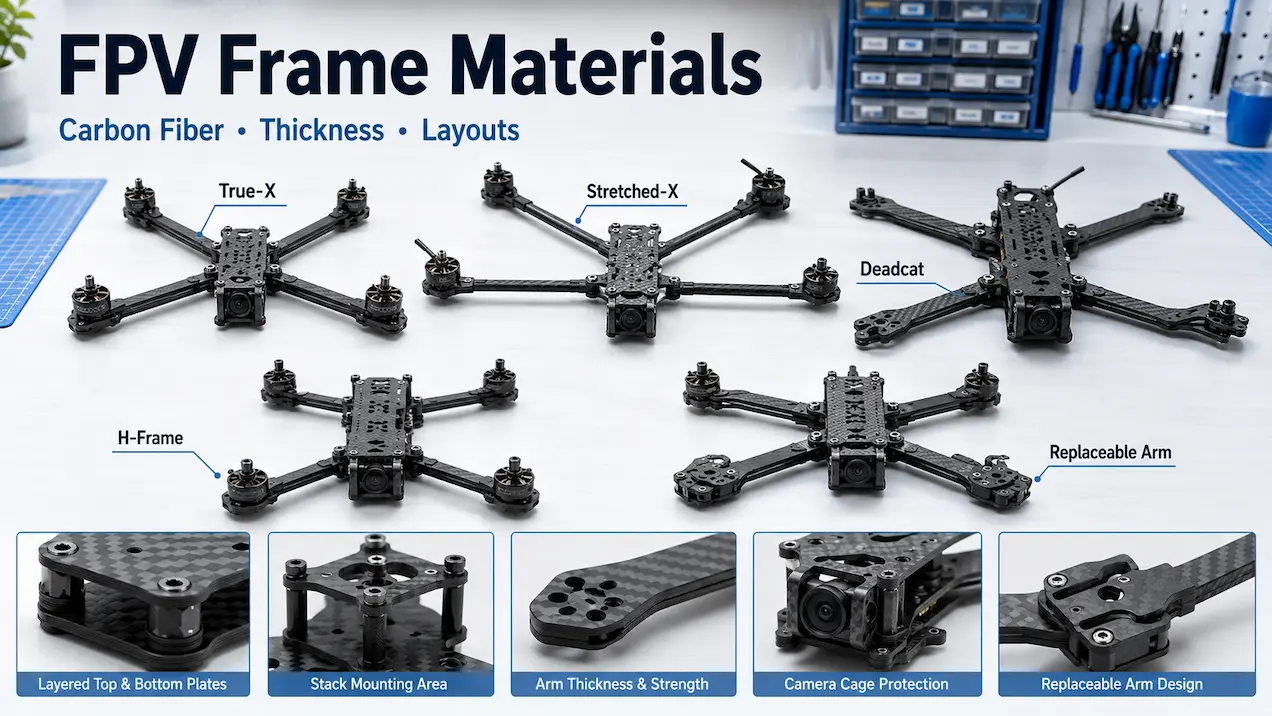
FPV Frame Materials: Carbon Fiber and Layouts
FPV frame materials determine how well a drone frame resists crashes, controls vibration, protects electronics, and holds geometry under motor load. Carbon fiber is the dominant material for outdoor FPV frames because it provides high stiffness at low weight, but thickness, weave quality, arm design, and layout matter more than the material name alone. This FPV frame materials guide explains how carbon fiber thickness, frame layouts, stiffness, vibration control, crash strength, and repairability affect real-world FPV drone performance.
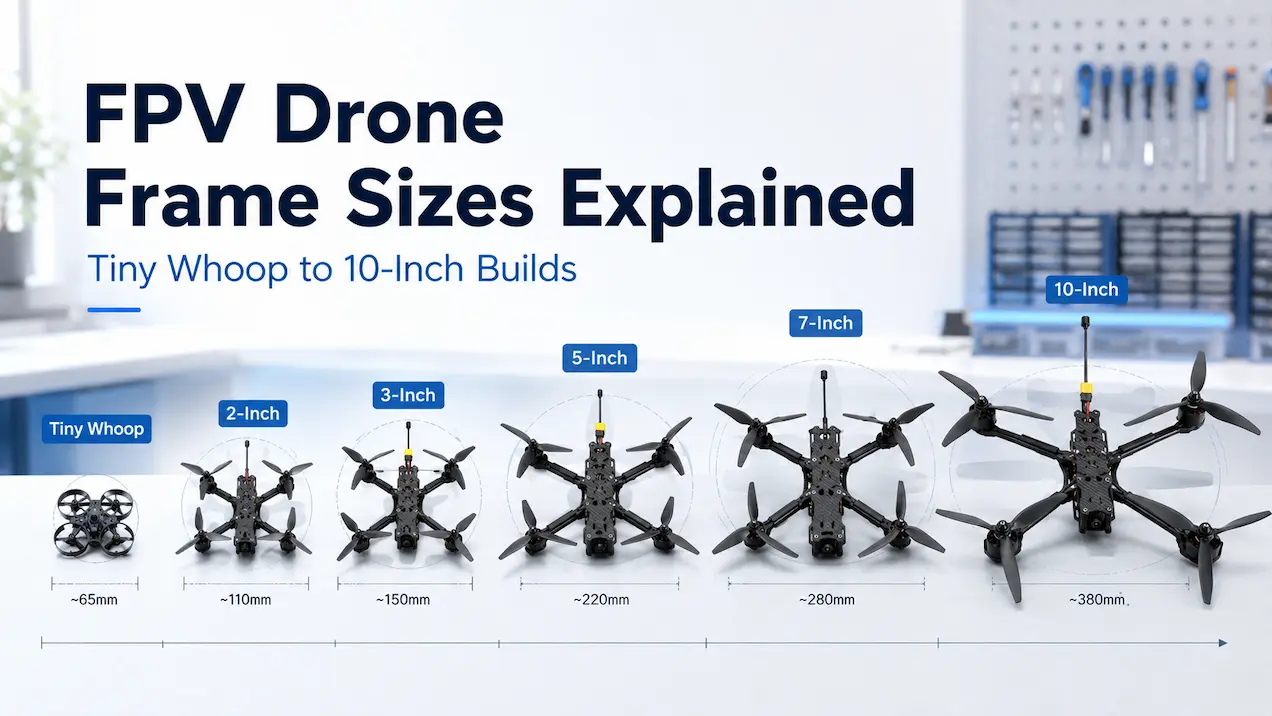
This guide focuses only on frame material behavior, carbon thickness, plate strength, and layout geometry. Frame class selection belongs in the previous guide on FPV frame sizes, while the next guide on 5-inch FPV frames covers the most common outdoor frame class in detail.
Why FPV Frame Material Matters
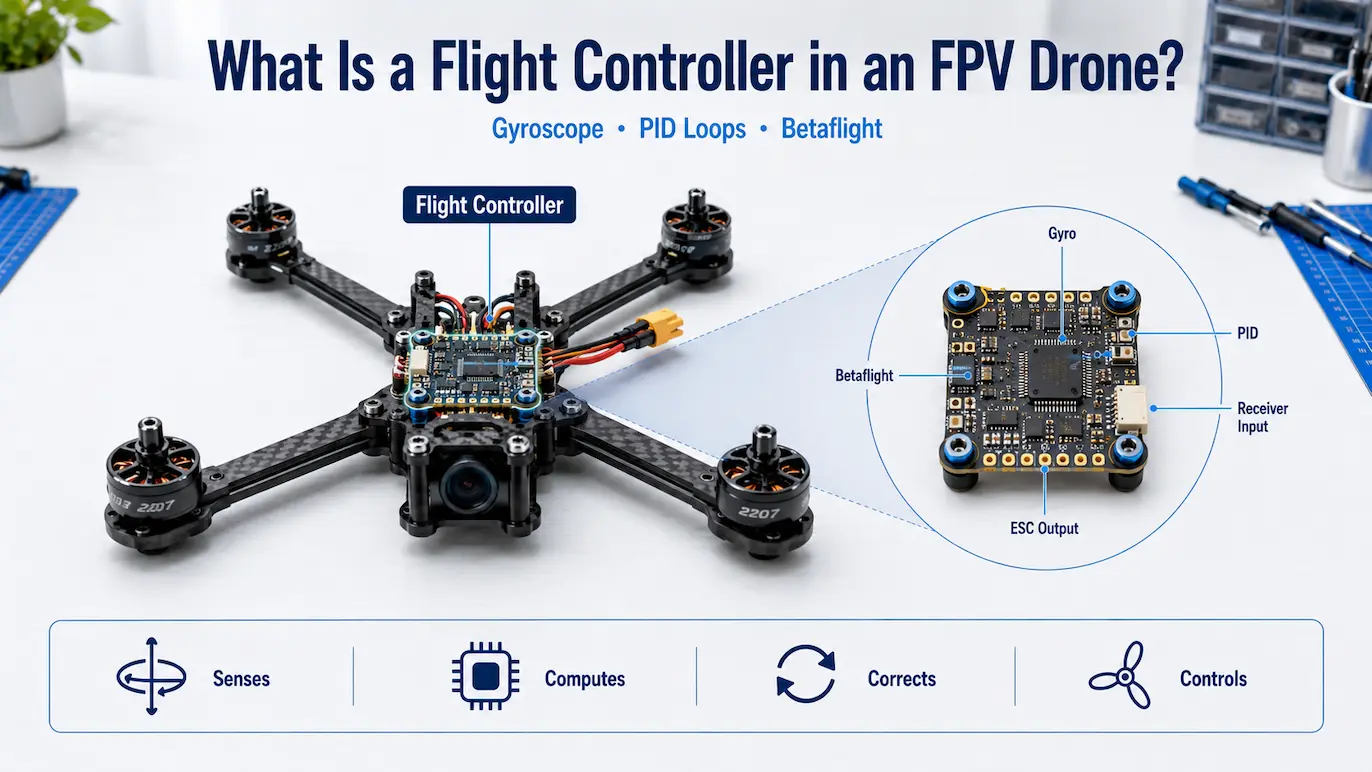
Frame material affects stiffness, vibration transfer, crash survival, weight, and component protection. A weak frame can bend, delaminate, crack, or transfer vibration into the flight controller. A stiff frame keeps the motors aligned, gives the gyro cleaner data, and makes tuning more predictable.
The frame is not only a shell. It controls the physical relationship between the motors, stack, camera, battery, antenna mounts, and arms. When that structure flexes too much, the aircraft can feel soft, noisy, or inconsistent during hard throttle changes.
A frame material should be judged by 5 properties:
- Stiffness: Resists bending under motor thrust.
- Impact strength: Survives crashes without cracking.
- Vibration behavior: Reduces unwanted oscillation.
- Weight: Keeps the aircraft responsive and efficient.
- Repairability: Allows arms, plates, and hardware to be replaced.
Carbon Fiber in FPV Frames
Carbon fiber is the standard material for most freestyle, racing, cinematic, and long-range FPV frames. It is light, stiff, and strong for its weight. It also allows thin plates and arms to carry high motor loads without making the frame too heavy.
Carbon fiber frames are usually made from layered sheets cut into arms, plates, braces, camera plates, and accessory mounts. Sheet quality, layer direction, resin consistency, cutting accuracy, and edge finishing all affect the final part.
Carbon Fiber Strength
Carbon fiber strength is directional. It performs best when the fibers are aligned with the load. This matters because FPV arms take bending force from motors, twisting force from crashes, and impact force from the ground.
A thick arm made from low-quality carbon can still perform worse than a thinner arm made from better material and cleaner layup. Thickness helps, but fiber quality and arm shape also matter.
Carbon Fiber Weak Points
Carbon fiber is stiff, but it is not flexible like plastic. It can crack, split, or delaminate during hard impacts. Delamination happens when the carbon layers separate. A delaminated arm may still look usable but can flex more and send vibration into the flight controller.
Carbon fiber is also electrically conductive. Battery leads, VTX wires, ESC pads, and receiver antennas should not rub against raw carbon edges. A sharp carbon edge can cut insulation and create an electrical short.
Carbon Fiber Thickness
Carbon fiber thickness changes crash strength, stiffness, weight, and flight feel. FPV frames commonly use thicker arms and thinner top or bottom plates because arms take the highest crash and motor-load stress.
Small micro frames may use 2 mm to 3 mm plates. Many outdoor freestyle frames use thicker arms because the motor ends hit the ground first during crashes. Larger long-range frames use thickness based on prop size, battery weight, and payload.
Arm Thickness
Arms take the most abuse because motors sit at the ends of the frame. During a crash, the arm can hit the ground before the body. During flight, the arm must resist motor torque and propeller vibration.
Thicker arms usually improve durability and stiffness. The tradeoff is weight. More arm weight increases rotational inertia, so the drone may feel less sharp during fast flips, rolls, and direction changes.
Plate Thickness
Top plates and bottom plates protect the stack, battery, camera, and internal wiring. They do not always need to be as thick as arms because they do not carry the same bending load from motors.
A thin top plate saves weight but can crack around screw holes or battery straps. A thicker bottom plate improves body strength but adds weight near the center of the frame. Central weight is usually less harmful than heavy motor-end weight, but it still affects total aircraft mass.
Thickness Is Not the Only Strength Factor
Thickness alone does not define frame strength. Arm width, cutout shape, screw spacing, carbon quality, fiber orientation, and stress concentration around holes all matter.
A narrow thick arm with aggressive cutouts can break faster than a slightly thinner arm with cleaner load paths. Rounded internal corners reduce stress concentration better than sharp internal corners.
Frame Layouts
Frame layout describes how the arms and body are shaped. Layout affects camera view, prop visibility, balance, flight feel, crash behavior, and component spacing.
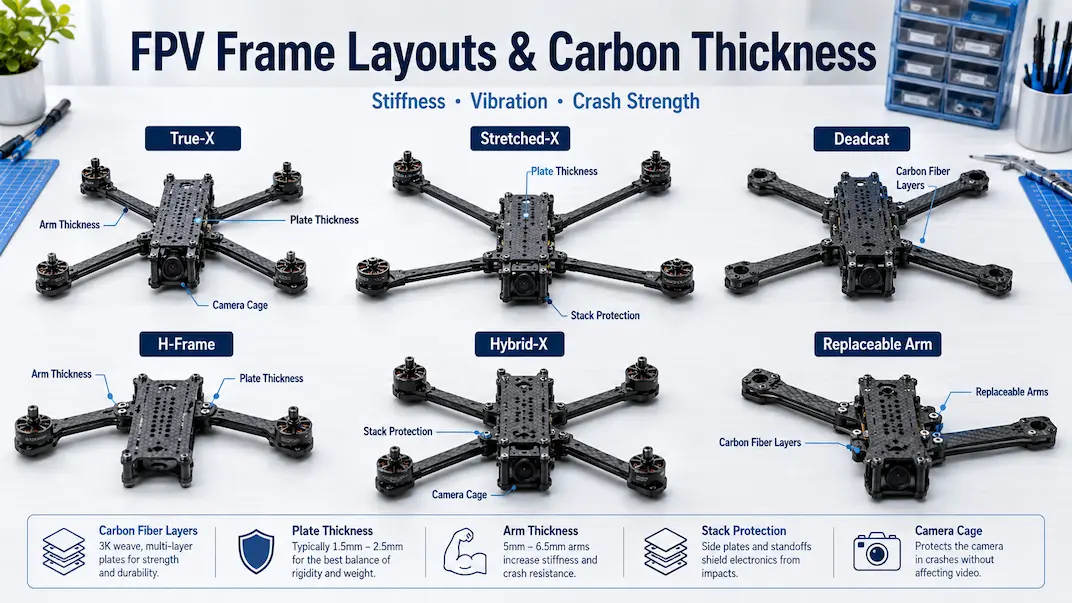
The main FPV frame layouts are true-X, stretched-X, deadcat, hybrid-X, H-frame, and plus-style layouts. Each layout changes how the drone responds to pitch, roll, yaw, and forward movement.
True-X Layout
A true-X frame places all 4 motors at equal diagonal spacing around the center. Roll and pitch geometry are balanced, which makes the aircraft feel predictable during freestyle movement.
True-X layouts are common for freestyle because they make flips, rolls, inverted moves, and direction changes feel even across both axes.
True-X Strengths
True-X frames feel balanced because the motor geometry is symmetrical. This helps pilots who want consistent rotation behavior during freestyle moves.
They also tend to be compact, which can improve durability because the arms are not stretched far from the body. Shorter arms can reduce flex when the carbon thickness and shape are correct.
True-X Limits
True-X frames can show propellers in the FPV camera view or HD camera view depending on camera angle and frame shape. They may also have less room between front arms for clean camera protection.
A true-X layout is not automatically better for racing or cinematic use. It is best when balanced freestyle response matters more than forward-flight stability or prop-free footage.
Stretched-X Layout
A stretched-X frame has more front-to-back length than side-to-side width. The motor geometry is stretched along the pitch axis.
This layout is common in racing because it can feel more stable in fast forward flight and can track better through gates.
Stretched-X Strengths
Stretched-X frames can improve forward-flight feel. The longer pitch axis can make the aircraft feel more locked in during fast lines.
Racing pilots often value that stability because gate approaches, straight sections, and fast corrections depend on predictable forward movement.
Stretched-X Limits
Stretched-X frames can feel less balanced for freestyle because pitch and roll do not behave exactly the same. The layout can also make the aircraft longer, which affects transport, crash angles, and camera protection.
This layout is best when fast forward flight matters more than symmetrical freestyle movement.
Deadcat Layout
A deadcat frame pushes the front arms outward so the propellers stay out of the camera view. This layout is common for cinematic FPV builds where clean footage matters.
Deadcat layouts are often used with HD cameras or digital video systems because they reduce visible props without requiring extreme camera angles.
Deadcat Strengths
The main benefit is cleaner footage. By moving front props away from the camera view, the frame helps capture forward video with fewer prop arcs.
Deadcat frames can also provide more front-body room for camera protection, digital air units, and soft-mounted camera platforms.
Deadcat Limits
Deadcat geometry is less symmetrical than true-X. The flight feel can be slightly different on pitch and roll because the motor positions are not evenly balanced.
Deadcat frames are not the first choice for pure racing or aggressive freestyle when symmetrical response matters more than clean camera view.
H-Frame and Hybrid Layouts
H-frame layouts use a longer rectangular body with arms placed around a central plate. Hybrid-X frames combine features from true-X, stretched-X, and deadcat designs.
These layouts are used when builders need more internal space, longer battery mounting, stronger camera protection, or cleaner electronics placement.
H-Frame Strengths
H-frames provide more body space for stacks, VTX units, receivers, GPS modules, capacitors, and wiring. They can also support longer battery placement and more protected electronics layouts.
This structure can help on cinematic or long-range builds where clean internal organization matters more than minimum weight.
H-Frame Limits
More body material usually adds weight. A longer body can also increase resonance if the plates are thin or poorly braced.
H-frames can feel less compact than true-X freestyle frames. They need careful carbon thickness and brace design to avoid flex.
Unibody vs Replaceable-Arm Frames
FPV frames usually use either unibody construction or replaceable arms. This choice affects weight, repair cost, crash recovery, and stiffness.
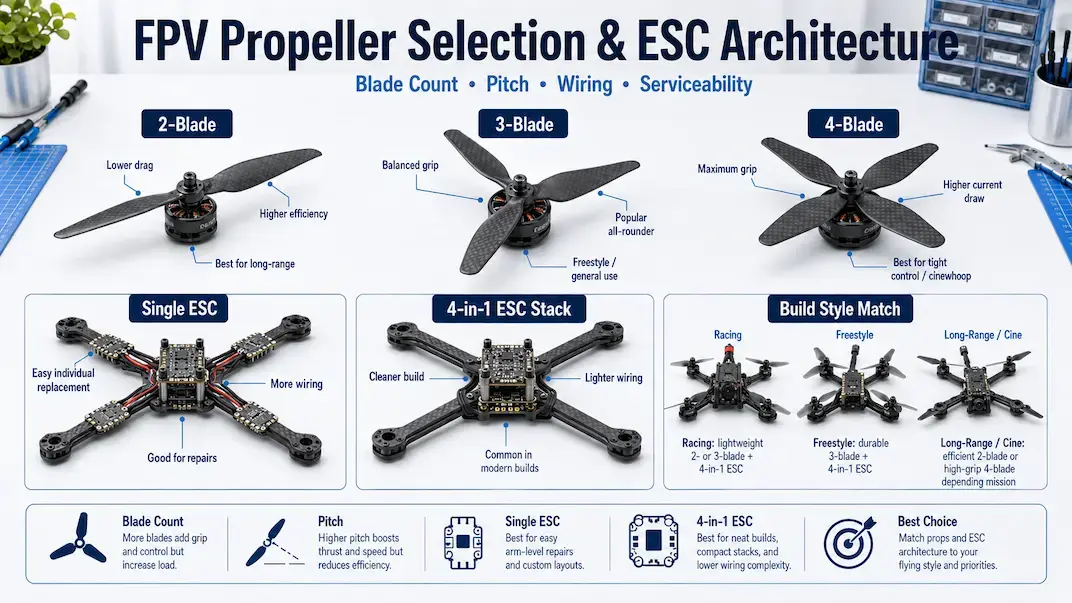
A unibody frame cuts all arms and the center plate from one carbon piece. A replaceable-arm frame uses separate arms bolted between body plates.
Unibody Frames
Unibody frames are lighter and simpler because they use fewer screws and overlapping plates. They are common in micro builds and some lightweight racing frames.
The downside is crash repair. If one arm breaks, the entire bottom plate may need replacement. That can cost more and require a larger rebuild.
Replaceable-Arm Frames
Replaceable-arm frames are better for freestyle and crash-heavy flying because one broken arm can be replaced without rebuilding the whole aircraft.
The tradeoff is hardware weight. Separate arms need screws, press nuts, plates, and overlap sections. A good replaceable-arm frame uses enough clamping area to stop arms from shifting during crashes.
Stiffness, Vibration, and Flight Controller Noise
Frame stiffness affects gyro data. A flexible frame can vibrate under motor load and send unwanted movement into the flight controller. The firmware then has to filter more noise, which can reduce responsiveness or heat motors.
Clean mechanical design makes tuning easier. Straight arms, tight hardware, balanced props, smooth motors, and stiff plates produce cleaner gyro traces than a bent or loose frame.
Resonance
Resonance happens when the frame vibrates strongly at certain frequencies. Long arms, thin plates, loose screws, and cracked carbon can increase resonance.
A frame with bad resonance may show hot motors, oscillations, prop wash problems, or unstable video. The issue may look like a tuning problem, but the root cause can be mechanical.
Hardware Tightness
Loose screws can make a strong carbon frame behave like a weak one. Arm screws, stack screws, camera screws, and standoffs should be checked after crashes.
Frame stiffness depends on both material and assembly. A well-cut carbon frame with loose hardware can still produce vibration, arm shift, and poor flight-controller data.
Camera and Stack Protection
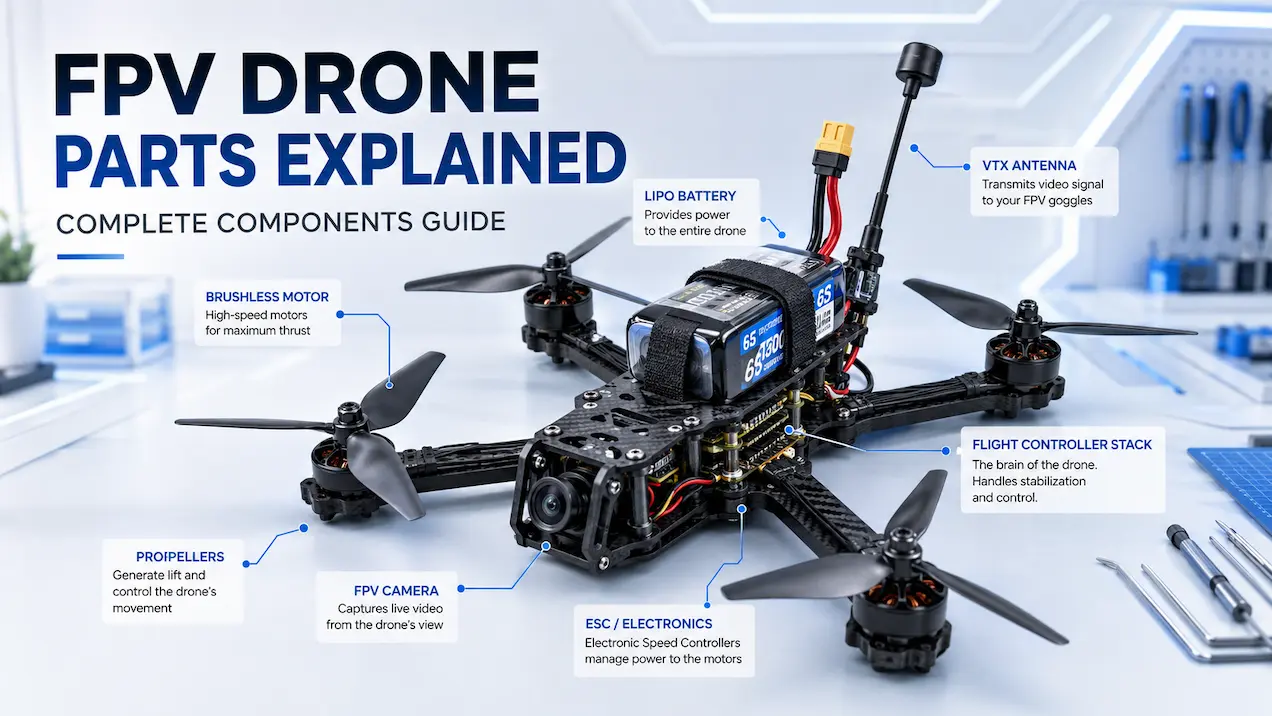
Frame layout affects how well the camera and electronics survive crashes. Carbon side plates, front bumpers, standoffs, and top plates can protect the camera cage and flight stack.
A good frame protects the camera without blocking the view. It also protects the stack without trapping too much heat around the VTX, ESC, or digital air unit.
Camera Cage
A camera cage holds the FPV camera and sets its protection level. Freestyle frames often use carbon side plates or aluminum hardware to protect the lens from front impacts.
A poor camera cage leaves the lens exposed or allows the camera angle to shift after crashes. That can change the pilot’s view and make the drone feel inconsistent.
Stack Protection
The stack area holds the flight controller and ESC. A frame should protect this area from direct ground hits, battery ejection, and prop strikes.
A low stack reduces height but may limit airflow and wiring space. A tall stack improves access but can expose electronics if the top plate or standoffs are weak.
Weight vs Durability Tradeoff
Every frame design balances weight and durability. A lighter frame accelerates faster, changes direction quicker, and uses less power. A stronger frame survives more crashes but adds mass.
Freestyle pilots usually accept extra weight for stronger arms and better camera protection. Racing pilots often reduce weight for acceleration. Cinematic pilots balance stiffness, camera protection, and vibration control.
The correct frame is not the thickest or lightest option. It is the frame that matches the crash risk, camera load, flying style, and repair plan.
For broader navigation across drones, frames, and power gear, OmnyxTech product categories keep the main site paths connected without turning this material guide into a product page.
Common Frame Material Mistakes
Frame material mistakes usually come from judging carbon by thickness alone or choosing layout by appearance instead of function.
Common mistakes include:
- Choosing thickness only: Carbon quality, arm width, and cutout shape also matter.
- Ignoring sharp edges: Raw carbon can cut wires during vibration or crashes.
- Using weak camera protection: An exposed camera lens breaks easily in front impacts.
- Overbuilding small frames: Too much carbon and TPU can make micro builds feel heavy.
- Ignoring arm replacement: A crash-heavy freestyle build benefits from replaceable arms.
- Choosing deadcat for all uses: Prop-free footage is useful, but geometry tradeoffs remain.
- Ignoring resonance: Vibration can come from frame flex, not only tuning.
- Forgetting hardware checks: Loose screws can ruin stiffness after a crash.
Frame Material Selection Checklist
Use this checklist before selecting an FPV frame material or layout:
- Carbon thickness: Match arm strength to crash risk and prop class.
- Arm shape: Avoid thin arms with aggressive cutouts near screw holes.
- Plate design: Check top and bottom plate thickness around straps and standoffs.
- Layout: Match true-X, stretched-X, deadcat, or H-frame to the flying style.
- Camera protection: Confirm lens and side protection before building.
- Stack protection: Check clearance, airflow, and crash exposure.
- Repair style: Choose replaceable arms for crash-heavy flying.
- Edge finishing: Smooth sharp carbon edges near wiring.
- Hardware access: Make sure arms and plates can be replaced without full teardown.
- Weight target: Avoid adding durability that the flight use does not need.
FAQ
Is carbon fiber the best material for FPV frames?
Carbon fiber is the best common material for most outdoor FPV frames because it is stiff, light, and strong for its weight. Plastic works for tiny whoops and protected micro frames, but larger freestyle, racing, cinematic, and long-range frames usually need carbon fiber for stiffness and crash resistance.
What carbon thickness is best for freestyle frames?
Many freestyle frames use thicker arms because the arms usually take the first impact in a crash. The best thickness depends on arm width, carbon quality, frame layout, and weight target. A well-shaped thinner arm can outperform a thicker arm with weak cutouts or poor carbon quality.
Is true-X better than deadcat?
True-X is better for balanced freestyle response because motor geometry is symmetrical. Deadcat is better when clean camera view matters because the front props are moved outward. Neither layout is universally better. The correct choice depends on whether flight feel or prop-free footage matters more.
Are replaceable arms worth it?
Replaceable arms are worth it for freestyle and crash-heavy flying because one broken arm can be replaced without changing the entire bottom plate. They add screws and overlap weight, but field repair is easier. Lightweight racing or micro builds may still use unibody frames to save weight.
Can frame material affect tuning?
Yes. Frame stiffness, arm flex, loose screws, cracked carbon, and resonance can affect gyro data. A noisy frame can force heavier filtering and make motors run hotter. Clean carbon design, tight hardware, balanced props, and straight arms usually make tuning easier.