FPV Drone Parts Explained: Complete Components Guide
FPV Drone Parts Explained:
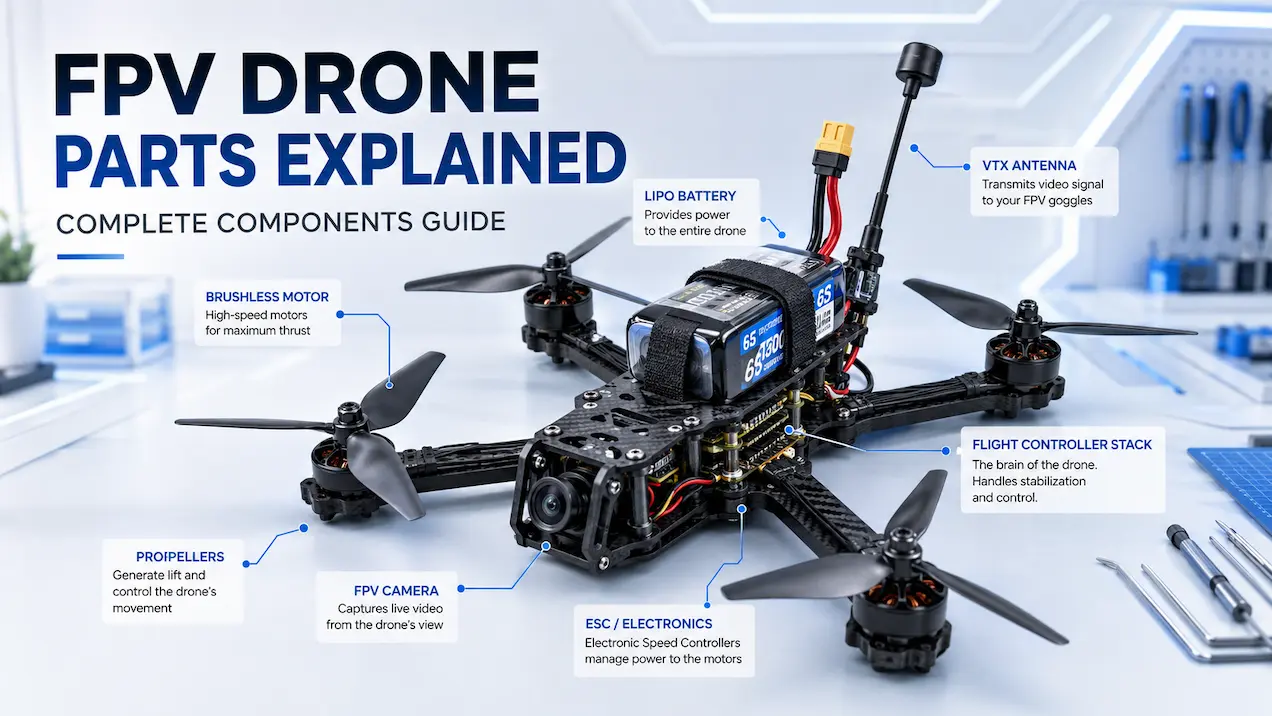
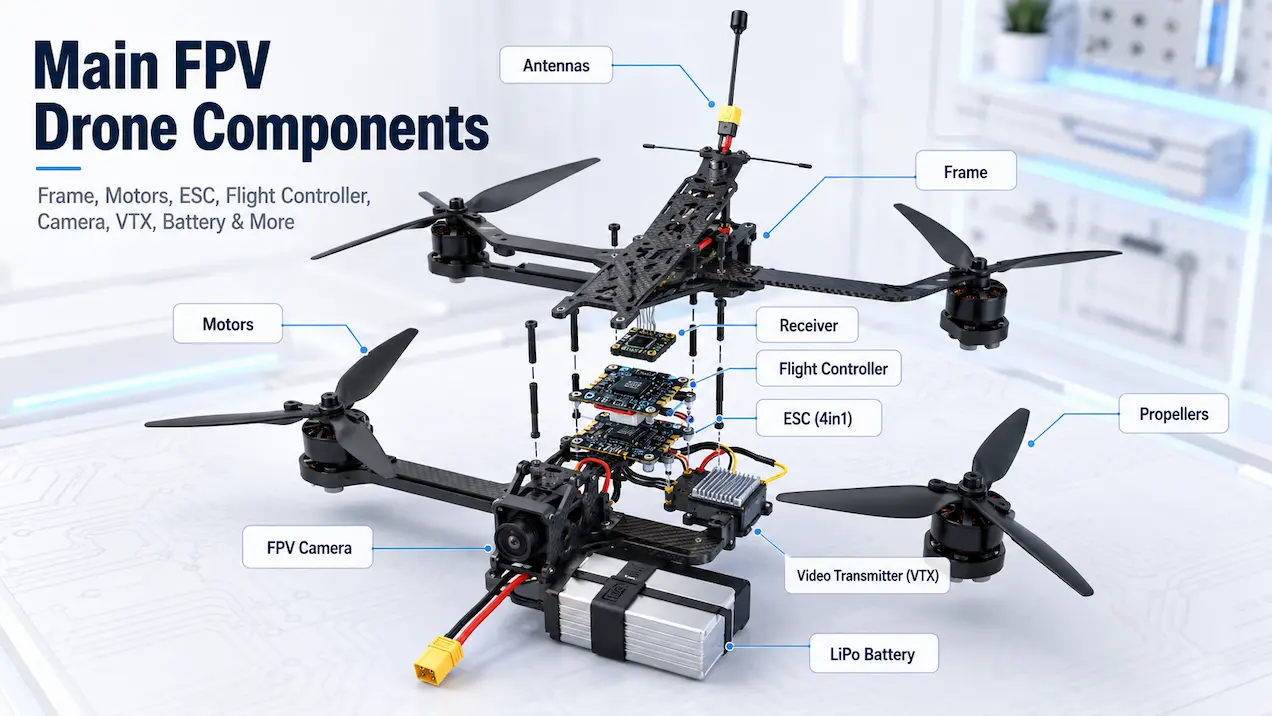
FPV drone parts form a connected aircraft system where the frame, motors, ESC, flight controller, receiver, camera, VTX, antennas, battery, and props must match each other. This FPV Drone Parts Explained guide explains what each component does, how the parts connect, and which compatibility details matter before a builder assembles or upgrades an FPV quad.
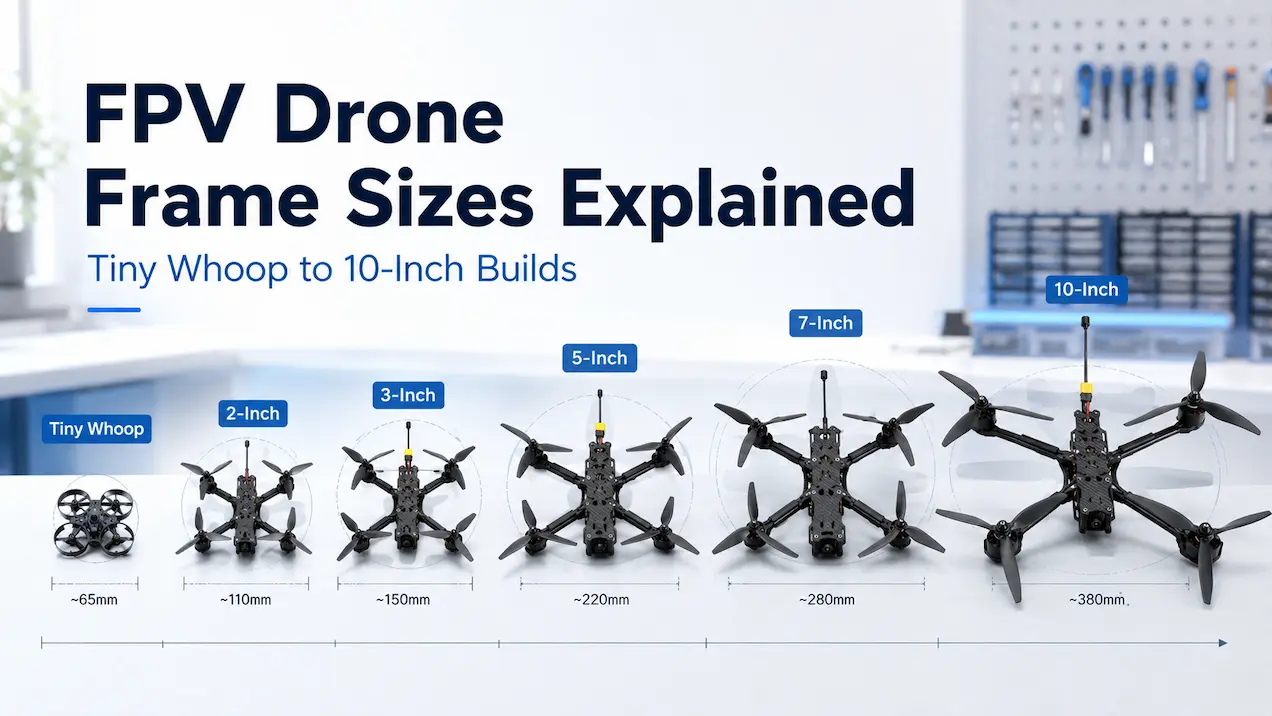
This article stays focused on component function and connection logic. Full flight behavior belongs in the previous guide on FPV flight modes, while frame-specific geometry belongs in the next guide on FPV frame sizes.
FPV Drone Parts List by System Role
An FPV drone parts list is easier to understand when each part is grouped by system role. A quadcopter does not work because it has expensive parts. It works because every part supports one of 5 jobs: structure, propulsion, control, video, or power.
The main FPV drone parts are:
- Frame: Holds every component and defines propeller size.
- Motors: Spin the propellers and create thrust.
- Propellers: Move air and convert motor torque into lift.
- ESC: Controls motor speed from flight-controller commands.
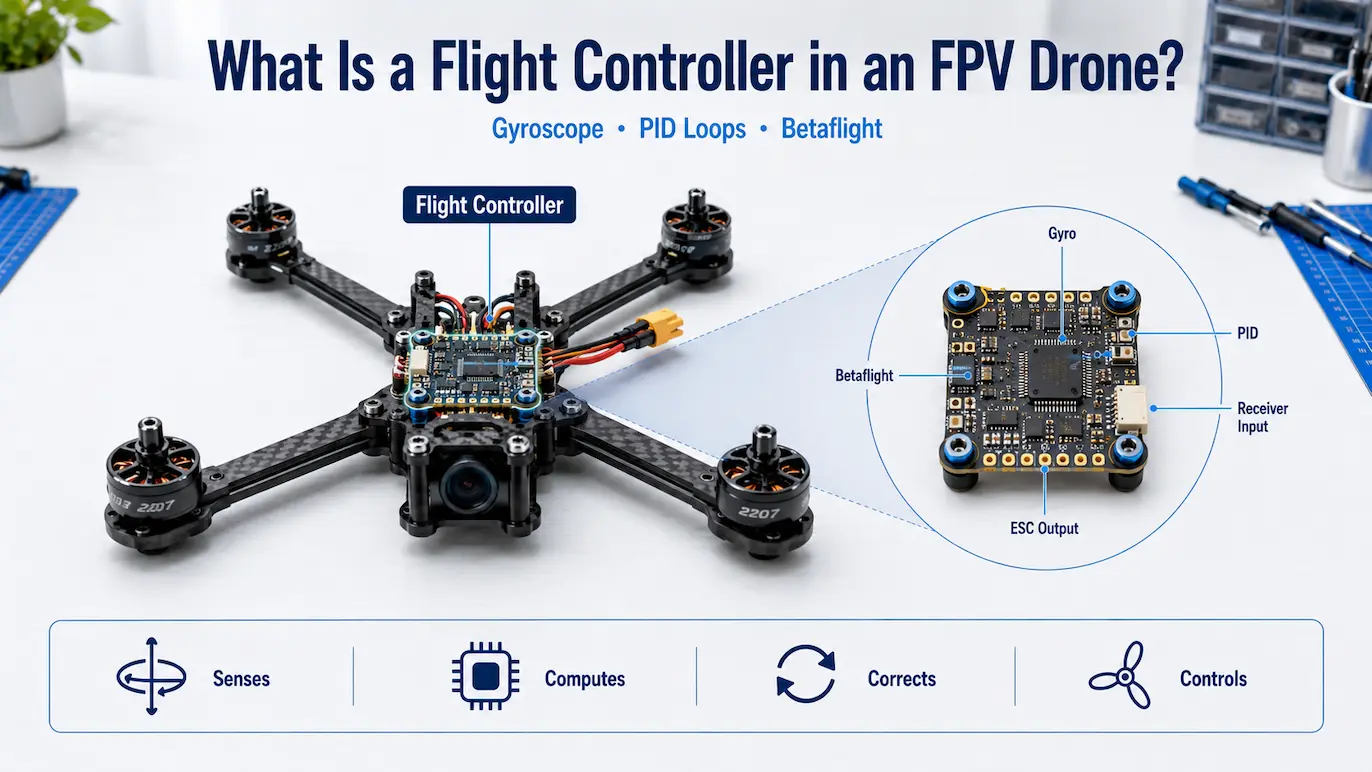
- Flight controller: Stabilizes the aircraft and processes pilot input.
- Receiver: Receives radio commands from the controller.
- Camera: Captures the pilot’s live forward view.
- Video transmitter: Sends the camera feed to the goggles.
- Antennas: Radiate and receive radio signals.
- Battery: Supplies power to the full aircraft.
- Power wiring: Carries battery voltage to the ESC, flight controller, and accessories.
- Mounting hardware: Secures stacks, motors, cameras, antennas, and accessories.
These parts are connected by physical mounting, electrical wiring, firmware configuration, and radio-frequency compatibility. A correct build requires all 4 layers to match.
Frame
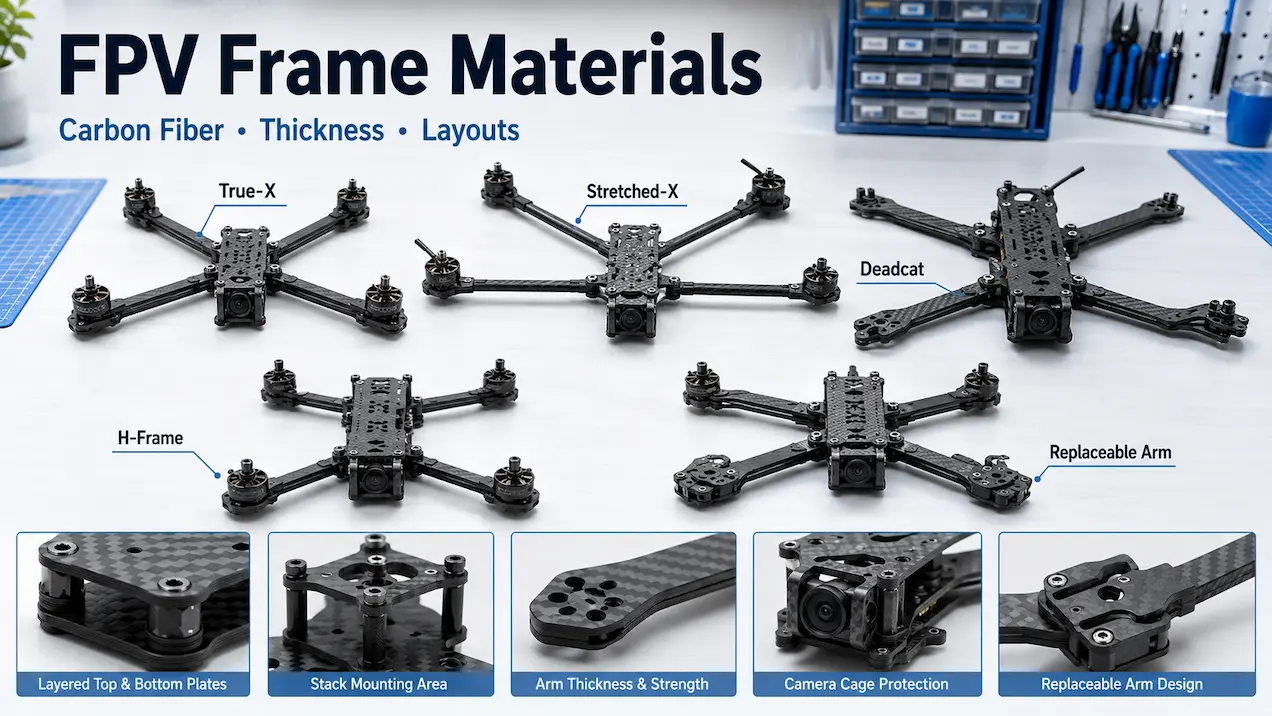
The frame is the structural base of an FPV drone. It determines propeller clearance, motor placement, stack mounting pattern, camera width, antenna position, battery location, and crash durability.
Most outdoor freestyle and racing quads use carbon fiber frames because carbon fiber is stiff, light, and impact resistant. The tradeoff is radio blockage. Carbon fiber can weaken antenna performance when receiver or video antennas are placed too close to plates, arms, or battery straps.
Frame Fitment
Frame fitment decides which parts can physically mount inside the build. The frame must match the propeller size, motor mounting holes, flight-stack pattern, camera width, VTX space, antenna position, battery strap route, and battery lead direction.
This section only covers component fitment. Full size-by-size frame behavior belongs in the next guide on FPV frame sizes.
Mounting Patterns
FPV frames use standard mounting patterns for electronics. Common flight-stack patterns include 20×20 mm, 25.5×25.5 mm, and 30.5×30.5 mm. Motor mounting patterns vary by motor size and frame class.
A 30.5×30.5 mm ESC stack will not fit a frame designed only for 20×20 mm mounting unless the frame has extra holes or an adapter. A micro camera will not fill a full-size camera cage without spacers. A full-size camera may not fit a narrow micro frame.
Arm Thickness
Arm thickness affects stiffness, weight, and crash resistance. A 5-inch freestyle frame often uses 5 mm or 6 mm arms. Racing frames may use lighter arms to reduce weight. Long-range frames may use thinner arms if efficiency matters more than repeated impact survival.
Thicker arms are stronger, but they add weight. More weight increases motor load, current draw, and battery use. A frame built for concrete freestyle needs different priorities than a frame built for smooth cruising.
Motors
Motors convert electrical power into propeller rotation. FPV drones use brushless motors because they provide high RPM, fast response, and better power-to-weight performance than brushed motors at larger sizes.
A motor is defined by stator size, KV rating, shaft size, mounting pattern, weight, magnet design, bearing quality, and voltage compatibility.
Motor Size
Motor size is usually written as 4 digits, such as 2207 or 2306. The first 2 digits describe stator width in millimeters. The last 2 digits describe stator height in millimeters.
A 2207 motor has a 22 mm wide stator and 7 mm stator height. A 2306 motor has a 23 mm wide stator and 6 mm stator height. Wider and taller stators can produce more torque, but they also add weight and can draw more current.
Common pairings:
- Tiny whoop: 0802, 1102, or similar micro motors.
- 3-inch quad: 1404, 1505, 1604, or similar motors.
- 5-inch freestyle: 2207 or 2306 motors.
- 7-inch long range: 2507, 2806.5, or similar larger motors.
Motor size must match propeller load. A small motor can overheat when forced to spin a large prop. A large motor on a small prop can add weight without improving efficiency.
Motor KV
Motor KV describes theoretical no-load RPM per volt. A 1750KV motor on 6S voltage, or 22.2V nominal, calculates to about 38,850 RPM before propeller load. That number is not real flight RPM, but it helps builders match motor speed to battery voltage and propeller size.
KV should be treated as a compatibility value, not a standalone performance score. High KV with too much voltage or too much propeller load can overheat motors and stress the ESC. Low KV with too little voltage can make the quad feel weak because the propeller cannot reach enough speed.
Propellers
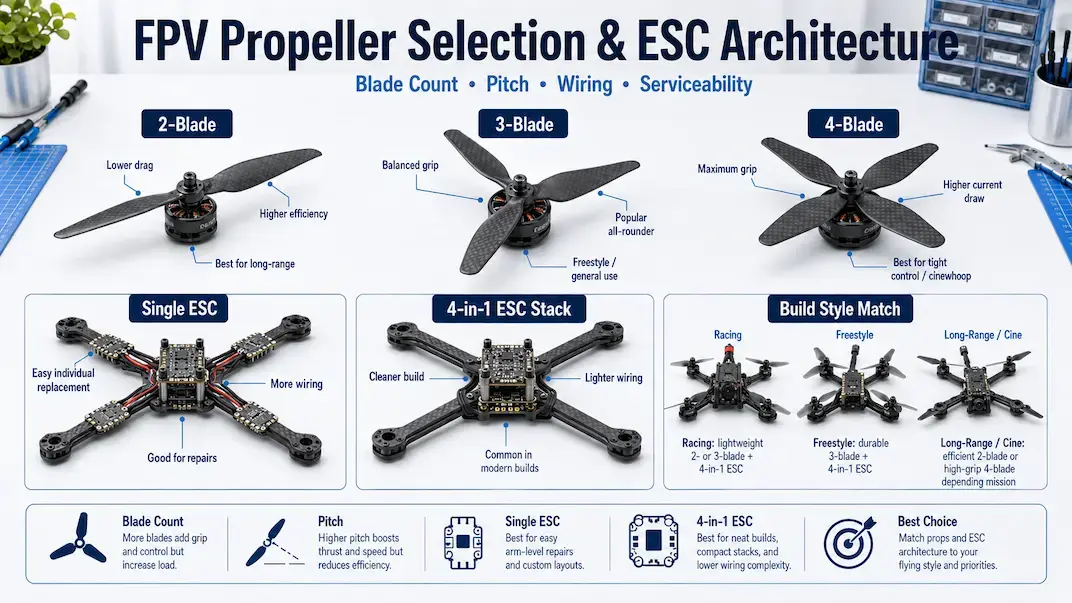
Propellers convert motor rotation into thrust. A propeller is defined by diameter, pitch, blade count, blade shape, material, hub size, and rotation direction.
A 5.1×3.6×3 prop has a 5.1-inch diameter, 3.6-inch pitch, and 3 blades. More pitch usually increases thrust and current draw. More blades can improve grip but reduce efficiency. Lower pitch often gives smoother throttle and lower current use.
Propeller Diameter
Diameter controls the disc area that moves air. Larger props can create more efficient lift at lower RPM, but they need larger frames and motors with enough torque.
Common prop sizes:
- 31–40 mm: Tiny whoops.
- 2–3 inches: Micro and toothpick builds.
- 3–3.5 inches: Cinewhoops and compact outdoor quads.
- 5 inches: Freestyle and racing quads.
- 6–10 inches: Long-range and heavier FPV aircraft.
A frame must provide safe prop clearance. Props that flex into frame arms, ducts, battery straps, or camera mounts can cause vibration, motor load spikes, or crashes.
Propeller Pitch
Pitch describes how far a propeller would theoretically move forward in one revolution through a solid medium. Higher pitch usually creates stronger bite and higher current draw. Lower pitch usually creates smoother control and better efficiency.
A high-pitch prop on a high-KV motor can overload the ESC during full throttle. A low-pitch prop on a heavy quad may feel underpowered because it cannot produce enough thrust quickly.
Propeller Direction
Quadcopters use 2 clockwise propellers and 2 counterclockwise propellers. The motor direction and prop direction must match firmware settings. A wrong prop direction can cause the drone to flip on takeoff or fail to lift.
Props are cheap compared with motors and ESCs. Damaged props should be replaced quickly because bent blades create vibration that affects gyro readings and video stability.
Electronic Speed Controller
The electronic speed controller, or ESC, controls motor speed. It receives throttle commands from the flight controller and switches battery power to the motors many times per second.
FPV drones usually use either a 4-in-1 ESC or individual ESCs. A 4-in-1 ESC is common in 5-inch builds because it saves space and simplifies wiring. Individual ESCs are more common on some larger aircraft because they spread heat and allow separate replacement.
ESC Current Rating
ESCs are rated by current capacity, such as 35A, 45A, 55A, or 65A. The rating must handle motor current under real propeller load, not just average cruising current.
A freestyle quad can draw high current during punch-outs, prop wash recovery, sharp reversals, and crashes where a motor is blocked. ESC headroom protects the board from brief current spikes.
A 45A 4-in-1 ESC can be enough for many 5-inch builds, but motor KV, propeller pitch, battery voltage, aircraft weight, and flying style decide the real load. A heavy build with aggressive props needs more margin than a light cruising build.
ESC Firmware
ESC firmware controls motor timing, braking behavior, startup behavior, and communication protocol. Common firmware families include BLHeli_S, Bluejay, BLHeli_32, and AM32.
The flight controller and ESC communicate through protocols such as DShot. DShot is digital, does not require throttle calibration, and supports features such as bidirectional telemetry when the firmware and setup allow it.
ESC firmware is not a standalone performance upgrade. It must match the motor, propeller, flight controller, and tuning goal.
Flight Controller
The flight controller is the central control board of an FPV drone. It reads gyro data, receives receiver commands, runs firmware logic, and sends motor commands to the ESC.
A flight controller does not create thrust. It decides how thrust should be distributed across the motors to match pilot input and stabilize the aircraft.
Processor and Gyro
Flight controllers commonly use F4, F7, or H7 processors. Faster processors provide more headroom for filters, blackbox logging, RPM filtering, OSD, GPS, and multiple peripherals.
The gyro measures angular movement. Clean gyro data helps the firmware filter vibration and stabilize the aircraft. Poor mounting, bent props, damaged motors, or loose screws can make gyro data noisy and cause unstable flight.
UARTs and Ports
UARTs are serial ports used to connect devices such as receivers, GPS modules, VTX control, telemetry, and digital video systems. A build with GPS, receiver telemetry, digital video, and external accessories needs more UART planning than a basic analog freestyle quad.
Before choosing a flight controller, check:
- Receiver protocol support.
- Number of UARTs.
- ESC connector compatibility.
- VTX control support.
- OSD support.
- Blackbox memory.
- Mounting pattern.
- Voltage input rating.
A flight controller can be technically powerful and still be wrong for a build if it lacks the ports or mounting pattern required by the frame and accessories.
Receiver and Radio Link Hardware
The receiver is the part of the drone that receives pilot commands from the radio transmitter. It sends stick inputs and switch positions to the flight controller.
The receiver must match the radio protocol. ExpressLRS, TBS Crossfire, FrSky, Spektrum, and other systems are not automatically cross-compatible.
Receiver Protocol
Receiver protocol affects range, latency, telemetry, packet rate, and binding process. A controller and receiver must use the same protocol and compatible firmware configuration.
A receiver also needs correct wiring. Many receivers connect to a UART using 5V, ground, TX, and RX pads. Some use inverted or uninverted signal pads depending on protocol and flight controller design.
Antenna Placement
Receiver antennas should be placed away from carbon fiber, battery leads, VTX antennas, and metal hardware. Carbon fiber can reduce signal strength. Battery mass can shadow the signal during turns.
A common 5-inch setup places receiver antennas at the rear arms, rear standoffs, or in a vertical mount. The best placement depends on frame layout and flight direction.
FPV Camera
The FPV camera captures the live image used for piloting. In a parts-focused build plan, the camera should be selected by size, mounting width, aspect ratio, voltage input, image behavior, and video-system compatibility.
This section does not repeat the video-link signal-chain article. The key component question is whether the camera physically and electrically fits the build.
Camera Size
Common FPV camera sizes include nano, micro, mini, and full-size formats. A frame designed for micro cameras may need adapters for nano cameras. A full-size camera may not fit a compact frame.
Camera mounting width matters because frame side plates hold the camera in position. If the camera is too narrow, it needs spacers. If it is too wide, it will not fit.
Camera Voltage
Some cameras accept 5V only. Others accept wider voltage ranges. The camera must receive stable power from the flight controller, VTX, or regulator.
Poor camera power can create flicker, blackouts, or unstable video. A camera should not be powered from a noisy source when a clean regulated pad is available.
Video Transmitter
The video transmitter, or VTX, sends the camera feed to the goggles. For component planning, the main questions are mounting size, input voltage, output power, antenna connector, cooling, control method, and compatibility.
A VTX is not selected only by maximum power. A high-power VTX with poor cooling, bad antenna placement, or incorrect channel setup can perform worse than a lower-power unit installed correctly.
VTX Mounting
VTX units can mount in a stack, on rear standoffs, or in a dedicated frame space. Small frames often require compact VTX boards. Larger frames may allow better airflow and antenna placement.
Heat matters. Video transmitters can overheat during bench setup when props are not moving air across the frame. Builders often use low-power mode, pit mode, or a fan during configuration.
VTX Control
Some VTX units support control through the flight controller. This allows channel and power changes through firmware or the on-screen display.
Correct VTX control wiring and firmware tables prevent mismatches between displayed settings and real transmitter output. This matters during group flying because wrong channel or power settings can interfere with another pilot’s feed.
Antennas
Antennas connect the drone’s radio systems to the air. FPV builds usually have at least one receiver antenna and one video antenna. Digital systems and diversity setups may use more.
Antennas must match frequency, connector type, polarization, and placement needs.
Video Antenna
Video antennas commonly use SMA, RP-SMA, U.FL, or MMCX connectors depending on VTX hardware. Connector mismatch can require an adapter, but adapters add length, weight, and possible failure points.
Circular-polarized video antennas are common for FPV because they handle reflections better than simple linear antennas in many flying environments. RHCP should match RHCP. LHCP should match LHCP.
Receiver Antenna
Receiver antennas are usually lighter and smaller than video antennas. They should be mounted so the active element is clear of conductive parts and not crushed by battery straps.
A receiver antenna damaged in a crash may still look attached but perform poorly. Range loss after a crash often comes from cracked antenna tubes, broken coax, loose U.FL connectors, or carbon blockage.
Battery
The battery supplies power to the full drone. FPV quads commonly use LiPo batteries for high-current performance. Some long-range builds use Li-ion packs for energy density and extended cruising.
Battery choice is defined by cell count, capacity, C-rating, connector type, weight, and physical size.
Cell Count
Battery cell count changes voltage. A 4S LiPo has 14.8V nominal voltage. A 6S LiPo has 22.2V nominal voltage. Fully charged voltage is 4.2V per cell, so a 4S pack charges to 16.8V and a 6S pack charges to 25.2V.
The motor KV, ESC rating, flight controller input, VTX input, and capacitor must support the battery voltage. A 4S-only component can fail on 6S power.
Capacity and Weight
Battery capacity is measured in milliamp-hours. Higher capacity can increase flight time, but it also adds weight. More weight forces the motors to work harder, which can reduce the benefit of the larger pack.
A 5-inch freestyle build often uses packs around 1100–1500 mAh on 6S or 1300–1550 mAh on 4S depending on motor KV, prop choice, and flying style. Heavier packs can make the quad feel slower and increase crash damage.
Connector Type
Common FPV battery connectors include XT30 and XT60. Smaller builds often use XT30. Larger 5-inch builds commonly use XT60.
Connector size affects current handling and resistance. A connector that is too small for the current load can heat up and waste power.
Capacitor and Power Filtering
A capacitor helps reduce voltage spikes and electrical noise from the power system. It is usually soldered near the ESC battery pads.
Capacitors are important because motors and ESCs create voltage noise during rapid throttle changes. That noise can affect the flight controller, video system, and other electronics.
A common 5-inch 6S build may use a low-ESR capacitor rated around 35V or higher. The voltage rating must exceed battery voltage with margin. A capacitor rated too close to pack voltage can fail.
Power filtering does not fix every problem. Bad solder joints, damaged motors, poor grounding, and incorrect wiring can still create noise.
Wiring and Soldering
Wiring connects the electrical system. Good wiring is short enough to reduce clutter, long enough to avoid tension, and routed away from moving parts, sharp carbon edges, and high-heat components.
Poor wiring can cause intermittent failures that are hard to diagnose. A wire can pass a bench test and fail during flight if vibration pulls it against carbon or a solder joint cracks.
Power Wires
Main battery wires carry high current from the battery connector to the ESC. These wires must be thick enough for the load and soldered securely.
Loose battery leads can arc, overheat, or disconnect during a crash. Battery wires should be secured so propellers cannot cut them.
Signal Wires
Signal wires carry receiver data, camera video, VTX control, GPS data, telemetry, or ESC communication. These wires carry less current but are sensitive to poor routing and broken pads.
Signal wires should not be pulled tight across sharp frame edges. A short service loop can protect pads from direct stress during crashes.
Solder Quality
Good solder joints are shiny, smooth, and fully bonded to the pad and wire. Cold solder joints look dull, cracked, or balled up. A cold joint can create resistance, heat, or intermittent failure.
FPV soldering requires correct iron temperature, clean tips, flux, and proper wire preparation. Large ESC battery pads need more heat than tiny receiver pads. Using the same technique on both can lift small pads or underheat large joints.
Mounting Hardware and Protection Parts
Mounting hardware keeps components in place during vibration and crashes. Screws, standoffs, gummies, TPU mounts, battery pads, straps, and heat shrink all affect reliability.
A drone can have correct electronics and still fail because a stack screw loosens, a camera mount shifts, or an antenna gets cut by props.
Soft Mounting
Flight controllers often use rubber gummies or soft mounts to reduce vibration transfer from the frame. Over-tightening stack screws can crush gummies and reduce their effectiveness.
Soft mounting should hold the board securely without locking it rigidly to the frame. A loose flight controller creates bad gyro readings. An over-compressed mount transfers motor vibration.
TPU Mounts
TPU mounts are used for antennas, cameras, GPS modules, receivers, and action cameras. TPU is flexible, light, and easy to print.
A good TPU mount protects the part without blocking airflow or radio signal. A bad TPU mount can trap heat, bend antennas, or place parts too close to props.
GPS Module
A GPS module is optional on many freestyle and racing builds, but common on long-range FPV drones. For parts planning, GPS adds wiring, UART use, mounting requirements, and firmware setup.
A GPS module needs a clear view of the sky. Mounting it under a battery, next to a high-power VTX, or inside carbon plates can reduce satellite performance.
GPS does not replace pilot skill or make a freestyle drone behave like a regular camera drone. It is an added navigation component that can support location data, rescue features, speed data, and distance information when configured correctly.
Buzzer and Lost Model Finder
A buzzer helps locate a crashed drone. It can be powered by the flight controller or by its own small backup battery.
A self-powered buzzer is useful because it can continue beeping after the main battery disconnects. This matters in tall grass, trees, abandoned buildings, and large outdoor flying areas.
A buzzer adds small weight, but it can save a full build. Losing a drone without a buzzer, DVR, or GPS coordinate can cost more than the part itself.
Component Compatibility Checklist
FPV drone parts must match across physical size, voltage, current, protocol, mounting pattern, and firmware support. A component can be high quality and still be wrong for a specific build.
Use this checklist before buying or assembling parts:
- Frame and props: Propeller size must fit the frame.
- Frame and motors: Motor mounting holes must match the arms.
- Motors and battery: Motor KV must match cell count.
- Motors and ESC: ESC current rating must handle expected motor load.
- ESC and flight controller: Connector pinout or solder pads must match.
- Flight controller and receiver: UART, voltage, and protocol must match.
- Camera and frame: Camera width and mounting style must fit.
- Camera and VTX: Signal type must match the video system.
- VTX and goggles: Transmission system must match receiver hardware.
- Antennas and VTX: Connector and polarization must match.
- Battery and electronics: Voltage must be supported by ESC, FC, VTX, and accessories.
- GPS and flight controller: UART availability and firmware support must exist.
- Buzzer and power: Backup battery or FC power wiring must be planned.
- Capacitor and battery: Voltage rating must exceed battery voltage.
- Frame and stack: Mounting pattern and stack height must fit.
This compatibility logic is more important than buying the most expensive part in each category.
Example 5-Inch FPV Parts Match
A common 5-inch freestyle build might use:
- 5-inch carbon frame with 30.5×30.5 mm stack mounting.
- 2207 1750KV motors for 6S power.
- 5.1-inch tri-blade props for freestyle grip.
- 45A or 55A 4-in-1 ESC with DShot support.
- F7 flight controller with enough UARTs.
- ExpressLRS receiver matched to the radio.
- Micro FPV camera matched to the frame cage.
- Analog or digital VTX matched to goggles.
- RHCP video antenna matched to the receiver antenna.
- 6S LiPo battery with XT60 connector.
- Low-ESR capacitor rated above pack voltage.
- Buzzer for crash recovery.
This example is not a universal recipe. It shows relationship matching. A 4S version would need different motor KV. A racing version might use lighter parts. A cinewhoop would need ducts, different props, and different motor choices. A long-range build would need larger props, efficient motors, GPS planning, and different battery priorities.
For broader navigation across FPV and power-related categories, OmnyxTech product categories keep the main site paths connected without turning this component guide into a product page.
Common FPV Parts Mistakes
Most FPV build failures come from part mismatch, poor wiring, wrong assumptions, or missing setup checks.
Common mistakes include:
- Wrong motor KV: High KV on high voltage overheats motors and ESCs.
- Wrong prop size: Props hit the frame or overload the motors.
- Weak ESC rating: Current spikes damage the ESC during aggressive flying.
- Wrong stack pattern: Electronics do not fit the frame.
- Bad camera size: The camera does not mount securely.
- Wrong antenna connector: The VTX and antenna do not physically connect.
- Mismatched polarization: Video signal becomes weaker than expected.
- No capacitor: Voltage noise creates video or electronics problems.
- Poor soldering: Cold joints create intermittent failures.
- Bad receiver placement: Carbon fiber blocks the control signal.
- No buzzer: A crash in grass or trees becomes harder to recover.
- Too much weight: Oversized batteries and accessories reduce flight performance.
- No airflow plan: VTX or electronics overheat during setup.
- No voltage check: 4S-only parts get connected to 6S power.
- No pinout check: ESC-to-flight-controller harness wiring does not match.
The safest build process checks fitment first, then voltage, then wiring, then firmware, then motor direction, then low-power bench behavior before props are installed.
FAQ
What parts are needed to build an FPV drone?
An FPV drone needs a frame, motors, propellers, ESC, flight controller, receiver, camera, video transmitter, antennas, battery, capacitor, wiring, and mounting hardware. Ground gear is separate and includes goggles, radio controller, charger, batteries, tools, and spare parts. The aircraft parts must match by size, voltage, current, protocol, and mounting pattern.
What is the most important FPV drone part?
The most important part depends on the failure point. The frame defines physical compatibility, the flight controller manages stabilization, the ESC drives motors, and the battery supplies power. No single part can compensate for a bad system match. A reliable build comes from correct relationships between frame size, motor KV, prop load, ESC rating, battery voltage, and wiring.
Can I mix FPV drone parts from different brands?
Yes, FPV parts from different brands can work together when voltage, mounting pattern, protocol, connector type, firmware support, and signal format match. Brand matching is less important than technical compatibility. A receiver must match the radio protocol, a VTX must match the goggles or receiver system, and an ESC must handle motor current safely.
Do FPV drone parts affect flight time?
Yes. Motors, props, battery capacity, frame weight, camera system, VTX, wiring, and accessories all affect flight time. A heavier quad needs more throttle to stay airborne. High-pitch props draw more current. Larger batteries store more energy but add weight. Efficient part matching improves usable flight time more than simply adding a bigger battery.
Should beginners build or use a BNF FPV drone?
A BNF drone reduces assembly work because the aircraft arrives mostly built, but the pilot still needs compatible goggles, radio, batteries, charger, and setup checks. A custom build teaches wiring, soldering, firmware, and repair skills. Beginners who dislike soldering often start with BNF. Builders who want repair confidence learn more from assembling parts themselves.