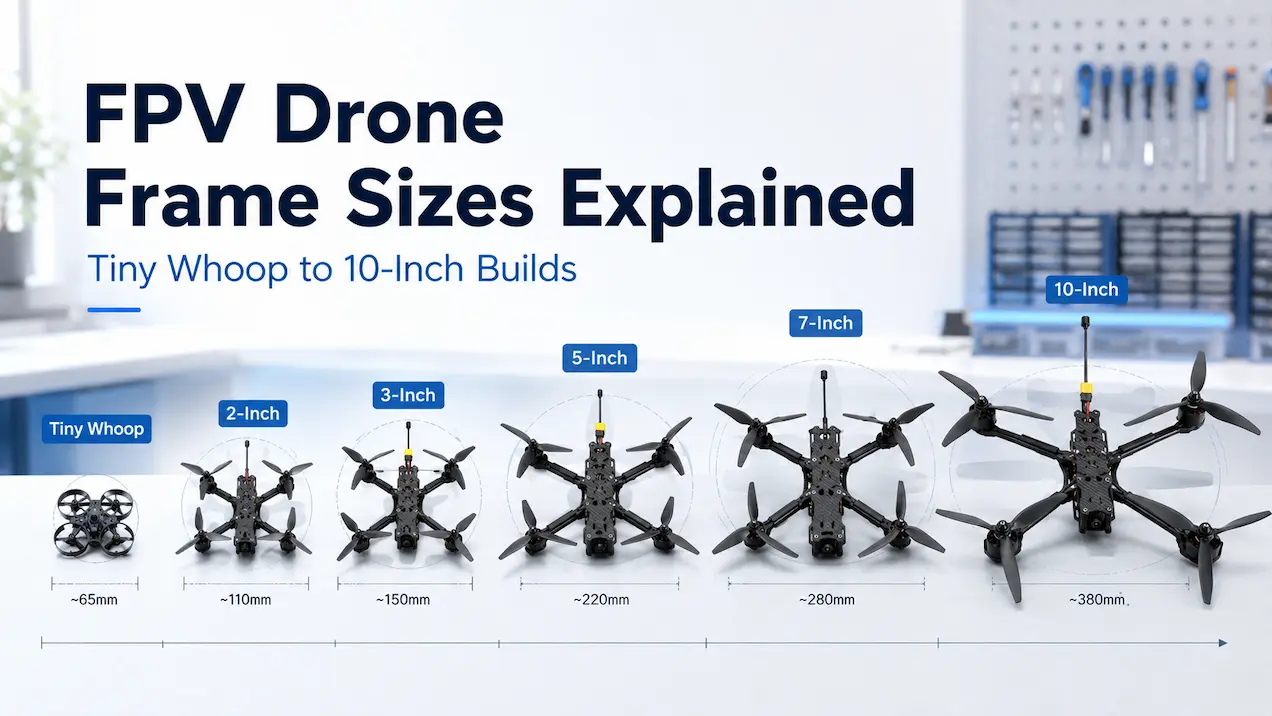
FPV Drone Frame Sizes Explained
FPV drone frame sizes define the propeller class, motor spacing, battery fit, payload limit, crash behavior, and flight area of a build. This FPV Drone Frame Sizes Explained guide shows how frame size decides whether the aircraft fits indoor practice, backyard cruising, freestyle, racing, cinematic flying, or long-range flight.
This guide focuses only on frame-size selection. For component fitment, the previous guide on FPV drone parts covers the full build list, while carbon thickness and layout tradeoffs are covered next under FPV frame materials.
How FPV Frame Sizes Are Measured
FPV frame size is usually described by the propeller size the frame is designed to carry. A 5-inch frame is built for 5-inch propellers. A 3-inch frame is built for 3-inch propellers. A 7-inch frame is built for 7-inch propellers.
Wheelbase is the diagonal motor-to-motor distance in millimeters. A typical 5-inch freestyle frame often sits around 220–250 mm. A 3-inch frame may sit around 120–160 mm. A 7-inch frame often moves into the 280–330 mm range.
Prop class matters more than wheelbase for most builders because propeller size directly affects thrust, current draw, noise, payload capacity, and required flying area.
Prop Size vs Wheelbase
Prop size tells you what propeller the frame clears. Wheelbase tells you how far the motors sit from each other. Both affect flight behavior, but they do not describe the same measurement.
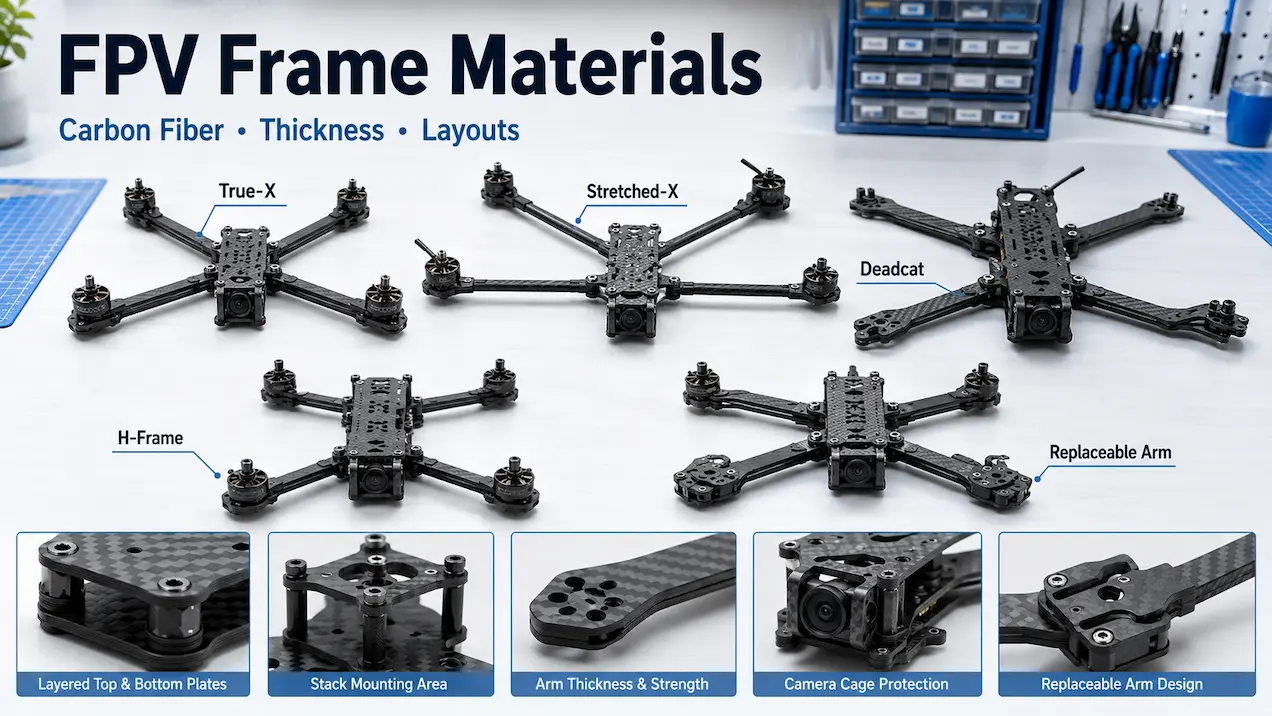
A stretched-X racing frame can have a longer front-to-back wheelbase than a true-X freestyle frame while both still use 5-inch props. The stretched frame can feel more stable in forward flight. The true-X frame can feel more balanced for freestyle moves.
Why Frame Size Changes Flight Feel
Smaller frames react quickly because they have less mass, shorter arms, smaller props, and lower rotational inertia. Larger frames react slower but carry bigger props, larger batteries, and heavier cameras.
A 2.5-inch quad can fit tight spaces but gets pushed by wind. A 5-inch quad handles outdoor freestyle well but needs more room and creates more noise. A 7-inch quad cruises efficiently over distance but feels slower during rapid flips and tight turns.
Tiny Whoop Frames: 31 mm to 40 mm Props
Tiny whoop frames are the smallest common FPV frame class. They use ducted propellers, small motors, light batteries, and compact electronics. Most are designed for indoor flying, low-speed practice, and safe close-range control.
These frames often use 31 mm, 35 mm, or 40 mm propellers. Many run 1S batteries, which keeps weight low and reduces crash damage.
Where Tiny Whoop Frames Work Best
Tiny whoops work best inside homes, garages, offices, small warehouses, and tight indoor tracks. Ducted propellers reduce the chance of cutting walls, furniture, people, pets, or wires during low-speed flight.
They are useful for learning throttle control because crashes usually cause less damage than larger aircraft.
Tiny Whoop Limits
Tiny whoops have limited outdoor performance. Wind affects them heavily because they weigh very little and use small props. Flight time is also limited because small batteries carry less energy.
They are not built for heavy payloads. Adding a large HD camera, oversized battery, or heavy antenna can make the aircraft sluggish.
2-Inch Frames
A 2-inch FPV frame sits between tiny whoops and larger outdoor micro builds. It can be ducted or open-prop depending on purpose.
Open-prop 2-inch frames are lighter and more efficient than ducted whoops, but they lose impact protection. Ducted 2-inch frames support close flying around objects, but ducts add drag and reduce efficiency.
Best Use Cases for 2-Inch Frames
A 2-inch frame fits small outdoor areas, quiet practice spots, backyard lines, light indoor spaces, and beginner-friendly micro flying. It gives more speed than a tiny whoop without needing the full space of a 5-inch quad.
This size can also work for lightweight cinematic practice when the build uses a small recording camera or compact digital system.
2-Inch Frame Limits
A 2-inch build has limited payload capacity. Heavy batteries, large digital video systems, or oversized camera mounts can overload the frame class quickly.
Wind remains a problem. A 2-inch quad can fly outside, but gusts push it more than a 3.5-inch or 5-inch aircraft.
2.5-Inch Frames
A 2.5-inch frame gives more propeller disc area than a 2-inch frame while staying compact. This size is common for toothpick builds, light freestyle micros, and quiet outdoor flying.
A well-matched 2.5-inch build can feel quick, responsive, and less intimidating than a 5-inch freestyle quad.
Best Use Cases for 2.5-Inch Frames
A 2.5-inch frame works well in parks, yards, small open fields, and lower-noise practice areas. It can handle more outdoor movement than a tiny whoop while remaining easier to transport than a full-size freestyle build.
Pilots use this class for casual flying, line practice, and outdoor orientation.
2.5-Inch Frame Limits
Every gram matters more on a 2.5-inch build than on a 5-inch build. A heavier camera, thick TPU mount, oversized receiver, or large battery can reduce flight performance quickly.
This size is not ideal for heavy action cameras or high-wind locations.
3-Inch Frames
A 3-inch frame is one of the most flexible micro classes. It can support outdoor freestyle practice, compact racing, light cinematic work, and stronger performance than 2-inch or 2.5-inch builds.
A 3-inch quad has enough propeller area to handle moderate wind better than smaller micros while staying compact enough for smaller flying areas.
Best Use Cases for 3-Inch Frames
A 3-inch frame works well for pilots who want outdoor capability without the full size, weight, and noise of a 5-inch aircraft. It is useful for small fields, open lots, backyard tracks, and compact freestyle spots.
This size is also common for lightweight HD builds when motors, battery, and frame weight are matched correctly.
3-Inch Frame Limits
A 3-inch frame cannot match the speed, authority, or payload capacity of a 5-inch freestyle quad. It can carry more than a 2.5-inch build, but overloading it removes the benefit of the smaller class.
Stack height, camera width, antenna placement, capacitor position, and battery lead routing must be planned before assembly.
3.5-Inch Frames
A 3.5-inch frame bridges the gap between micro builds and full-size 5-inch quads. It gives more propeller area than a 3-inch frame while staying smaller and usually quieter than a 5-inch aircraft.
This class is useful when a pilot wants stronger outdoor performance but does not need full 5-inch speed or payload capacity.
Best Use Cases for 3.5-Inch Frames
A 3.5-inch frame can work for freestyle, cruising, light cinematic flying, and compact outdoor practice. It has enough prop area to carry moderate electronics more comfortably than a 3-inch build.
Some pilots prefer this size for smaller fields because it can feel more controlled than a 5-inch quad.
3.5-Inch Frame Limits
A 3.5-inch frame can become heavy if the build uses oversized motors, thick TPU, large batteries, and full-size digital gear. Once weight climbs too far, the quad loses the efficient feel that makes the class useful.
Open-prop 3.5-inch frames also do not provide duct protection around people or objects.
Cinewhoop Frames
Cinewhoop frames use ducts or prop guards for close-proximity flying. Most cinewhoops use 2.5-inch, 3-inch, or 3.5-inch props, depending on payload and flight area.
Ducts add protection, but they also add weight, drag, and noise. This changes throttle behavior and battery use.
Where Cinewhoop Frames Work Best
Cinewhoop frames work best for slower controlled movement near objects, buildings, vehicles, and indoor spaces. The goal is controlled positioning, not maximum speed.
A 2.5-inch cinewhoop fits tighter spaces. A 3-inch cinewhoop carries more camera weight. A 3.5-inch cinewhoop supports heavier payloads but needs more room and stronger motors.
Cinewhoop Frame Limits
Ducts reduce direct prop contact but do not remove impact risk from weight, speed, or hard surfaces.
Cinewhoop frames also use more power than open-prop frames of similar size because ducts create drag and camera payload adds weight.
5-Inch Frames
A 5-inch frame is the standard outdoor freestyle and racing class for many FPV pilots. It balances thrust, agility, durability, parts availability, and repairability.
The 5-inch class is popular because it can fly aggressively without becoming too large to transport or repair. It also has enough room for a full flight stack, receiver, video system, capacitor, battery strap, and camera mount.
Best Use Cases for 5-Inch Frames
A 5-inch frame works best for outdoor freestyle, racing practice, open-field flying, parks, bandos, and general skill development. It can carry a lightweight action camera more comfortably than smaller frame classes.
This size gives strong control authority during dives, flips, rolls, and recovery moves.
5-Inch Frame Limits
A 5-inch quad needs space. It is louder, faster, and more dangerous than micro classes. It is not the correct size for small indoor rooms or tight public areas.
Heavy action cameras, oversized batteries, large antennas, and thick mounts can make the aircraft feel less responsive.
6-Inch Frames
A 6-inch frame adds propeller size and efficiency compared with a 5-inch frame. It can suit cruising, smoother freestyle, and lighter long-range setups.
A 6-inch quad may cruise with less throttle than a 5-inch quad when properly matched. Larger propellers also make the aircraft feel less snappy during rapid direction changes.
Best Use Cases for 6-Inch Frames
A 6-inch frame works for pilots who want longer cruising lines, smoother outdoor flight, and more efficient movement without jumping to a full 7-inch platform.
It can also work in windy areas where smaller frames feel unstable.
6-Inch Frame Limits
A 6-inch frame is less common than 5-inch and 7-inch classes, so parts availability may be narrower.
This size can sit in an awkward middle zone. It is not as agile as a 5-inch freestyle quad and not as efficient as a well-built 7-inch long-range aircraft.
7-Inch Frames
A 7-inch frame is a common long-range and efficient cruising class. It supports larger props, bigger batteries, GPS modules, stronger antennas, and smoother forward flight.
This size is not mainly about tricks. It is about distance, stability, efficiency, and controlled cruising.
Best Use Cases for 7-Inch Frames
A 7-inch frame works well for mountain cruising, open-field range, coastal lines, rural flying areas, and efficient cinematic movement. It can support Li-ion battery packs or larger LiPo packs depending on the build goal.
The larger frame gives more room for GPS placement, antenna separation, battery mounting, and HD camera support.
7-Inch Frame Limits
A 7-inch quad is not a beginner indoor or backyard aircraft. It covers ground quickly, carries more energy, and needs careful battery planning.
The larger props have more rotational inertia, so the aircraft does not change direction as sharply as a 5-inch quad.
8-Inch to 10-Inch Frames
Frames from 8 inches to 10 inches move into larger long-range, payload, and specialty aircraft territory. These frames are built for efficiency, endurance, payload support, or specific mission layouts.
They are less common for casual freestyle because they are larger, louder, heavier, and slower to recover from fast attitude changes.
Best Use Cases for 8-Inch to 10-Inch Frames
These frames work for heavier camera payloads, long cruising routes, mapping-style movement, and specialty builds that need more lift than 7-inch aircraft can provide.
They also provide more room for GPS modules, antennas, power wiring, batteries, and camera mounts.
Large-Frame Limits
Large frames require more planning. Motor size, prop load, ESC rating, battery type, wire gauge, vibration control, and landing area matter more because the aircraft carries more mass.
Crash risk also increases because larger aircraft can damage props, arms, motors, batteries, and payloads more severely.
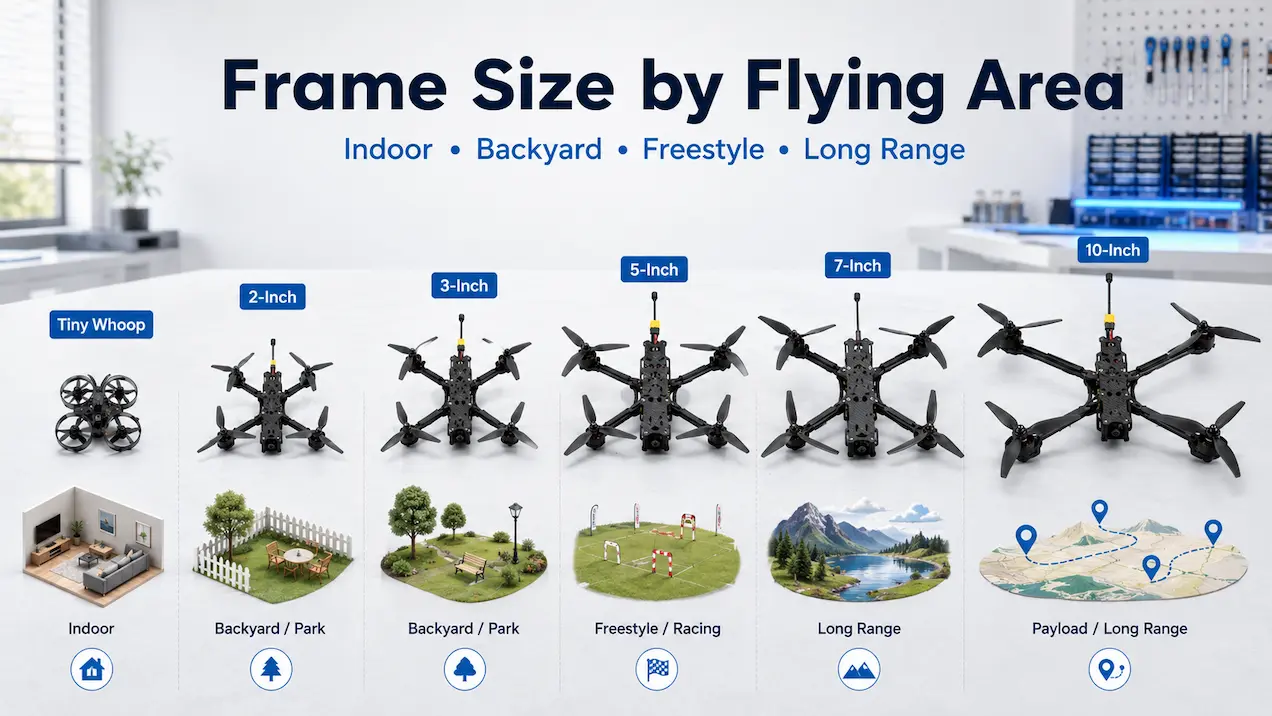
Frame Size by Flying Area
The best frame size depends on the available flying area. A frame that works well in a large field can be a poor choice inside a garage or small park.
| Flying Area | Better Frame Range | Reason |
|---|---|---|
| Small indoor rooms | Tiny whoop | Protected props and low mass |
| Garage or warehouse | Tiny whoop to 2.5-inch ducted | Ducts help near walls |
| Backyard | 2-inch to 3-inch | Lower noise and smaller flight area |
| Small park | 2.5-inch to 3.5-inch | Compact outdoor control |
| Open field | 5-inch | Strong freestyle platform |
| Mountain or coastal route | 7-inch | Efficient cruising |
| Payload-focused route | 8-inch to 10-inch | More lift and component space |
Frame Size by Use Case
Frame size should match the job. A popular 5-inch freestyle frame is a bad indoor trainer. A tiny whoop is a bad high-wind outdoor cruiser. A 7-inch frame is not ideal for tight freestyle gaps.
Beginner Practice
Tiny whoops, 2-inch builds, and 2.5-inch frames are better for early control practice because they reduce speed, noise, and crash cost.
A beginner who starts with a 5-inch quad must manage more speed, more repair cost, and more safety distance.
Freestyle
A 5-inch frame remains the most common freestyle size because it balances thrust, response, durability, and parts support. A 3.5-inch frame can work for smaller areas. A 6-inch frame can work for smoother lines.
Freestyle frame choice should consider arm strength, camera protection, stack space, battery mounting, and prop clearance.
Racing
Racing frames usually favor low weight, stiff arms, fast repair, and clean aerodynamics. Many racing builds use 5-inch frames because the class has strong parts support and established race-course compatibility.
The correct racing frame size depends on the track. A tight indoor course does not need the same aircraft as an outdoor gate course.
Cinematic Flying
Cinematic frame size depends on camera payload and proximity risk. A small cinewhoop works near objects. A 5-inch cinematic build works for fast outdoor movement. A 7-inch frame works for smoother long lines and heavier camera support.
The frame should match the shot path. Tight indoor footage needs protection and slow control. Open landscape movement needs stability and efficient cruising.
Long-Range Cruising
Long-range frame choices usually start around 6-inch and 7-inch classes, then move larger when payload or endurance demands increase.
A long-range frame should provide clean GPS placement, strong antenna location, secure battery mounting, and enough space to separate noisy electronics from sensitive receivers.
Common Frame-Size Mistakes
Frame-size mistakes usually happen when pilots choose a size before defining flight area, payload, noise limits, and repair expectations.
Common mistakes include:
- Choosing too large for the area: A 5-inch quad is too fast for many small spaces.
- Choosing too small for wind: Tiny whoops and 2-inch builds struggle in gusts.
- Overloading micro frames: Heavy cameras and batteries ruin small-frame performance.
- Ignoring prop clearance: Props can strike ducts, arms, straps, wires, or mounts.
- Buying by wheelbase only: Prop class and layout matter more than one diagonal number.
- Ignoring battery fit: A frame can fit electronics but fail to hold the intended battery.
- Forgetting repair parts: Arms, plates, mounts, and hardware should be available.
- Using the wrong frame for payload: Camera weight changes motor load and flight time.
The cleanest selection method is to start with the flight area, then choose prop class, confirm payload, check battery fit, and verify parts availability.
Practical Frame-Size Selection Checklist
Use this checklist before choosing a frame size:
- Flying area: Indoor, backyard, park, open field, or long-range route.
- Prop protection: Required for people, walls, vehicles, or indoor routes.
- Payload: No camera, small HD camera, action camera, or heavier payload.
- Noise limit: Smaller frames are usually easier in lower-noise areas.
- Wind exposure: Larger frames handle wind better than tiny whoops and micros.
- Battery plan: The frame must hold the battery without blocking props.
- Electronics space: The frame must fit the stack, receiver, VTX, GPS, and capacitor.
- Repair access: Arms, plates, mounts, and hardware should be replaceable.
- Skill level: Smaller aircraft reduce crash energy during early practice.
- Flight goal: Training, freestyle, racing, cinematic movement, or cruising.
For broader navigation across drones, frames, and power gear, OmnyxTech product categories keep the main site paths connected without turning this sizing guide into a product page.
FAQ
What FPV frame size is best for beginners?
A tiny whoop, 2-inch, or 2.5-inch frame is usually better for early practice because the aircraft is lighter, slower, quieter, and cheaper to crash. A 5-inch frame gives stronger outdoor performance, but it needs more space and carries more impact energy.
Is a 5-inch FPV frame still the standard size?
Yes, 5-inch frames remain the standard outdoor freestyle and racing class because they balance thrust, agility, durability, repairability, and parts availability. They are not ideal for indoor rooms or tight public areas.
What is the difference between 3-inch and 5-inch FPV frames?
A 3-inch frame is smaller, quieter, lighter, and better for compact outdoor spaces. A 5-inch frame has more thrust, better wind handling, stronger freestyle authority, and more payload capacity.
Are 7-inch FPV frames good for freestyle?
A 7-inch frame can perform basic freestyle, but it is not the best choice for tight tricks, quick reversals, or repeated crashes. The 7-inch class is better for cruising, long-range lines, open landscapes, and smoother cinematic movement.
Should frame size match prop size exactly?
Yes, the frame should be designed for the intended prop size. Oversized props can hit arms, ducts, battery straps, wires, or camera mounts. Undersized props may work physically but can reduce efficiency or change the intended flight feel.