How to Choose a Portable Power Station for Home Backup
How to Choose a Portable Power Station for Home Backup
Choosing the right portable power station for home backup can make a huge difference when the power goes out. Whether you want to keep your refrigerator running, charge phones and laptops, power lights, support medical devices, or stay connected during storms, the right unit gives your home a safer and quieter backup power option than relying only on gas generators.
Power outages are not always short. A small outage may last only an hour, but severe weather, grid problems, or emergency conditions can leave a home without power much longer. That is why more homeowners are looking at portable power stations, solar generators, and rechargeable battery backup systems as part of their emergency plan.
But not every power station is built for home backup. Some are only good for phones and small electronics. Others can run refrigerators, freezers, routers, CPAP machines, small appliances, tools, and even larger devices depending on their wattage and battery size. This guide explains how to choose the right portable power station for your home so you do not waste money on a unit that is too weak or too limited.
What Is a Portable Power Station?
A portable power station is a rechargeable battery system with built-in outlets, USB ports, and charging inputs. Think of it as a large battery bank designed to power more than just a phone. Depending on the model, it may include AC outlets, USB-C ports, DC ports, car charging, and solar panel input.
Unlike a gas generator, a portable power station does not burn fuel while running. It stores electricity in a battery and delivers that power when needed. This makes it useful indoors, in apartments, garages, RVs, campsites, and homes where noise, fumes, and fuel storage are concerns.
Most modern power stations are used for:
- Home backup during outages
- Emergency power for refrigerators and freezers
- Charging phones, laptops, tablets, and routers
- Running lights, fans, and small appliances
- Camping, overlanding, and RV backup
- Solar charging with compatible panels
- Backup for work-from-home setups
For home backup, the goal is not just portability. The goal is to choose enough power, capacity, safety, and charging flexibility for the appliances you actually need.
Start With What You Need to Power
Before buying anything, make a list of the devices you want to run during an outage. This is the most important step because your home backup needs may be very different from someone else’s.
For example, a basic emergency setup may only need to power:
- Phone chargers
- Wi-Fi router
- LED lights
- Laptop
- Small fan
A stronger home backup setup may need to power:
- Refrigerator
- Freezer
- CPAP machine
- Modem and router
- TV
- Microwave for short use
- Coffee maker
- Electric blanket
- Medical equipment
A high-capacity setup may need to support:
- Multiple refrigerators
- Larger appliances
- Power tools
- Sump pump
- Portable AC unit
- Several rooms of essential devices
The more appliances you want to run, the larger your power station needs to be. This is where wattage and battery capacity become important.
Understand Wattage Before You Buy
Wattage tells you how much power a device needs while running. Every portable power station has a maximum AC output rating, usually shown in watts. If the appliance needs more watts than the power station can provide, it may not run at all.
For example:
- Phone charger: low wattage
- Laptop: low to medium wattage
- Wi-Fi router: low wattage
- Refrigerator: medium wattage with startup surge
- Microwave: high wattage
- Coffee maker: high wattage
- Space heater: very high wattage
For home backup, you should look at two wattage numbers:
Running Watts
Running watts are the continuous watts a device uses while operating. If your refrigerator uses 150 watts while running, your power station must be able to supply that power continuously.
Surge Watts
Some appliances need extra power for a few seconds when starting. Refrigerators, freezers, pumps, compressors, and some tools may have a startup surge. A power station may handle 1,000 running watts but allow a higher surge rating for a short moment.
This matters because a power station that looks strong on paper may still fail if it cannot handle the startup surge of your appliance.
Choose the Right Battery Capacity
Battery capacity is usually listed in watt-hours, written as Wh. This tells you how much energy the power station can store.
A simple way to understand it:
If a device uses 100 watts and your power station has 1,000Wh of capacity, it could theoretically run that device for about 10 hours. In real use, the runtime will be lower because of inverter loss, battery protection, temperature, and efficiency.
Here is a basic formula:
Runtime = Battery Capacity ÷ Device Wattage
Example:
1,000Wh power station ÷ 100W device = about 10 hours before efficiency loss
For home backup, use this as a planning tool, not an exact promise. Appliances like refrigerators do not run at full power all the time. They cycle on and off, so actual runtime can vary depending on room temperature, food load, appliance age, and how often the door is opened.
Recommended Capacity by Use Case
For light emergency backup, a 300Wh to 700Wh power station can be enough for phones, laptops, routers, lights, and small fans.
For refrigerator and essential home backup, a 1,000Wh to 2,000Wh power station is usually a better starting range.
For longer outages or multiple appliances, look for 2,000Wh and above, especially if the unit supports expandable batteries.
For serious home backup, consider a larger expandable power station or a system that can connect with solar panels and extra battery packs.
Look for LiFePO4 Battery Chemistry
Battery chemistry is one of the most important features to check. Many newer power stations use LiFePO4 batteries, also called lithium iron phosphate batteries.
LiFePO4 batteries are popular because they usually offer:
- Longer cycle life
- Better thermal stability
- Stronger long-term durability
- Better value over many years of use
- More reliable performance for backup power
For a home backup power station, LiFePO4 is often the better choice if you plan to use the unit regularly or keep it for long-term emergency preparedness.
Older lithium-ion models may still work, but if two power stations have similar pricing and specs, the LiFePO4 model is usually the smarter long-term buy.
Check How Fast It Recharges
A portable power station is only useful if you can recharge it efficiently. Before buying, check all charging options.
The best home backup power stations usually support:
- Wall charging
- Solar panel charging
- Car charging
- USB-C charging on smaller models
- Dual charging on some advanced models
Wall charging is the fastest and easiest option when grid power is available. Solar charging is important during longer outages, camping, off-grid use, or emergency situations where you may not know when power will return.
If you plan to use solar panels, check the solar input rating. A power station with weak solar input may take too long to recharge, even if the battery is large.
Solar Charging: Important for Longer Outages
A portable power station with solar panel support can be more useful during extended outages because you are not fully dependent on the wall outlet. This is why many people call them solar generators.
However, a solar generator is not magic. Solar charging depends on:
- Solar panel wattage
- Sunlight conditions
- Weather
- Panel angle
- Solar input limit of the power station
- Cable compatibility
For home backup, solar is best when you pair the right power station with the right number of panels. A large 2,000Wh unit with only a small 100W panel may recharge very slowly. If you want real backup performance, match the solar panel setup to the battery size.
Check the Outlet Types
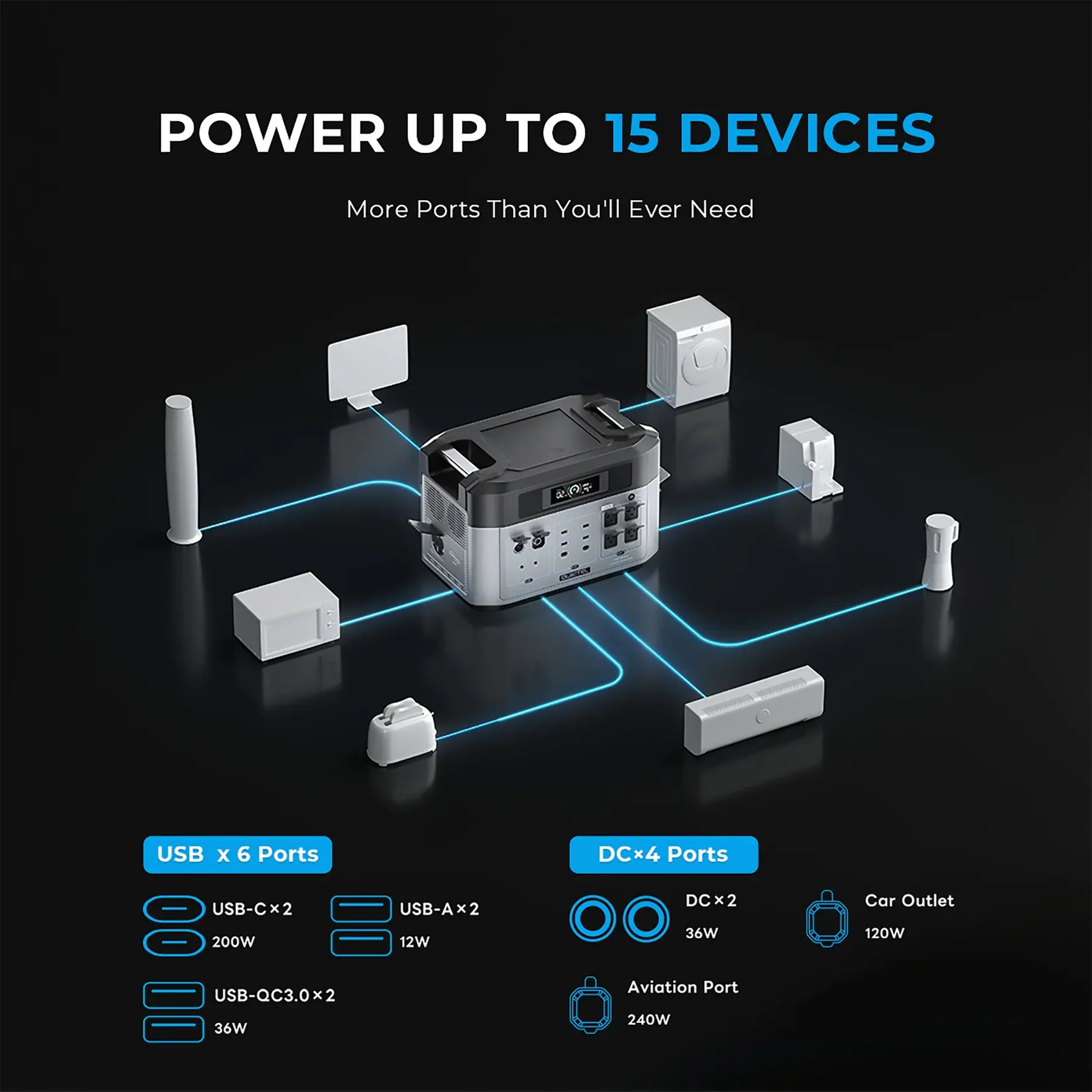
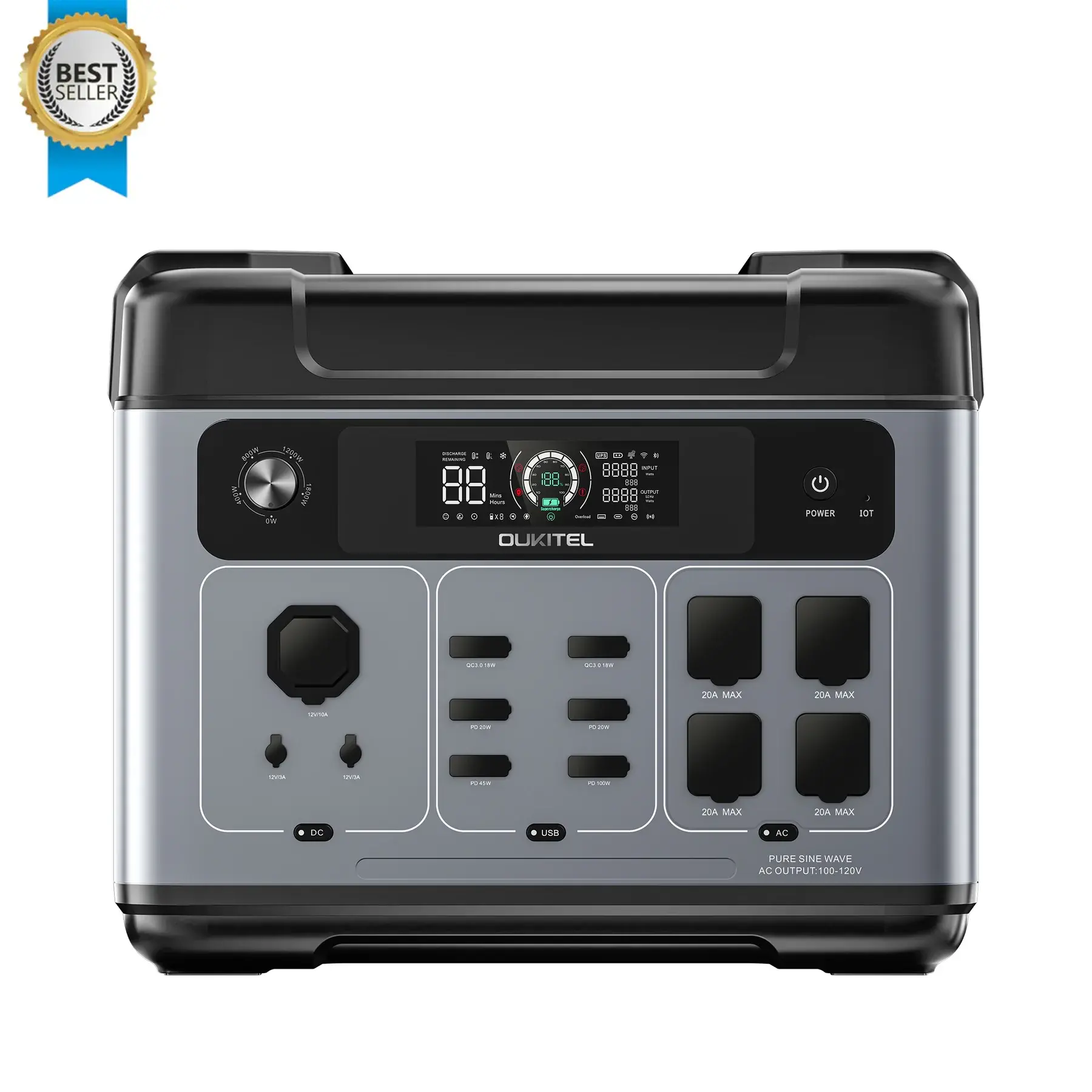
Not all power stations have the same ports. Before buying, check whether the unit has enough outlets for your devices.
Useful ports include:
- AC outlets for appliances
- USB-A ports for basic charging
- USB-C PD ports for laptops and modern devices
- DC output for certain electronics
- Car socket output
- Solar input port
For home backup, AC outlets matter most because they let you power common household devices. USB-C is also important if you want fast laptop and phone charging without using an AC adapter.
Decide Between Portable and Expandable
Some power stations are compact and easy to carry. Others are heavier but offer more capacity. The right choice depends on your needs.
A smaller portable unit is better if you want:
- Easy carrying
- Camping use
- Basic emergency backup
- Charging electronics
- Apartment-friendly backup
A larger expandable unit is better if you want:
- Refrigerator backup
- Longer outage protection
- More appliance support
- Solar charging
- Extra battery expansion
If your main goal is home backup, do not focus only on weight. A very lightweight unit may be convenient but too small for serious outage use.
Think About Noise and Indoor Safety
One major reason people choose portable power stations is indoor usability. Since they run on stored battery power, they do not create exhaust while operating. That makes them very different from gas generators, which must be used outdoors and away from the home because of carbon monoxide risk.
For indoor home backup, a battery power station is usually quieter and more convenient. You can place it near your router, refrigerator, workspace, or bedroom depending on what you need to power.
Still, you should follow the manufacturer’s safety instructions. Keep the unit dry, avoid blocking vents, do not overload it, and use proper cables.
Do Not Ignore Refrigerator Backup
For many homes, the refrigerator is the most important appliance during an outage. Losing a fridge or freezer full of food can be expensive.
When choosing a portable power station for refrigerator backup, check:
- Running wattage of your refrigerator
- Startup surge requirement
- Battery capacity in Wh
- Inverter output in watts
- Estimated runtime
- Whether the power station supports pass-through or UPS-style backup if needed
A small 300Wh power station may charge phones and laptops, but it is usually not the right choice for refrigerator backup. For that, you generally want a stronger unit with enough AC output and battery capacity.
Consider UPS or EPS Features
Some power stations include UPS or EPS-style features. These allow the unit to switch over quickly when grid power fails. This can be useful for Wi-Fi routers, computers, security systems, or work-from-home setups.
If you want backup for sensitive electronics, look for:
- Fast transfer time
- Pure sine wave inverter
- Stable AC output
- Overload protection
- Battery management system
- App monitoring if available
A pure sine wave inverter is especially important for many appliances and electronics because it delivers cleaner power than modified sine wave output.
Internal Product Link Placement
If you are ready to compare backup power options, you can explore our recommended portable power stations.
This is the best place to link to your OmnyxTech portable power station category page, solar generator collection, or a specific product such as a high-capacity OUKITEL power station.
Follow OmnyxTech for Backup Power Tips
For quick product updates, solar power tips, and emergency backup ideas, follow OmnyxTech on Instagram.
This sentence gives you a natural outbound social link without making the article feel promotional or forced.
Key Features to Compare Before Buying
When comparing portable power stations, do not only look at price. A cheaper unit may have lower capacity, weaker output, slower charging, or shorter battery life.
Here are the most important features to compare:
1. Battery Capacity
Look at watt-hours. Higher Wh means longer runtime.
2. AC Output
Check running watts and surge watts. This decides what appliances the unit can power.
3. Battery Type
LiFePO4 is usually better for long-term home backup.
4. Solar Input
Higher solar input means faster recharging with panels.
5. Charging Speed
Fast wall charging is useful before storms or planned outages.
6. Number of Outlets
Make sure the unit has enough AC, USB, USB-C, and DC ports.
7. Expandability
Expandable battery support is useful for longer outages.
8. Weight and Portability
Choose a size you can move safely.
9. App Control
App monitoring can help you track battery level, input, output, and runtime.
10. Warranty and Support
A power station is an emergency device, so good support matters.
Common Mistakes to Avoid
Many people buy the wrong portable power station because they only look at price or total watt-hours. Avoid these mistakes:
Buying Too Small
A small power station may be fine for phones but not enough for home backup.
Ignoring Surge Watts
Refrigerators, pumps, and compressors may need extra startup power.
Forgetting Solar Input
A large battery with weak solar input may take too long to recharge.
Only Looking at Peak Watts
Peak watts are not the same as continuous running watts.
Not Checking Appliance Wattage
Always check the wattage label or manual for your appliances.
Expecting Whole-Home Backup From a Portable Unit
Most portable power stations are designed for essential devices, not every appliance in the home.
Choosing the Cheapest Option
The cheapest unit may cost more later if it has weak battery life, limited ports, or poor output.
How Big of a Power Station Do You Need?
Here is a simple buying guide:
For phones, lights, routers, and laptops, choose 300Wh to 700Wh.
For refrigerator backup and essential devices, choose 1,000Wh to 2,000Wh.
For longer outages, multiple appliances, or solar backup, choose 2,000Wh or more.
For serious home backup, choose an expandable battery system with strong AC output and high solar input.
The best choice depends on your actual power needs. A family that only wants internet and phone charging may not need a huge system. A family that wants to protect food, run medical devices, and stay powered overnight should choose a larger model.
Portable Power Station vs Gas Generator
Portable power stations and gas generators both provide backup power, but they work very differently.
A portable power station is quiet, rechargeable, indoor-friendly, and easier to use. It does not require gasoline while running and is better for small to medium backup needs.
A gas generator can provide higher power for larger loads, but it is noisy, requires fuel, produces exhaust, and must be used outdoors with strict safety precautions.
For many homes, the best setup is a portable power station for indoor essential devices and solar charging for longer backup flexibility.
Final Checklist Before You Buy
Before choosing a portable power station for home backup, ask yourself:
- What devices do I need during an outage?
- How many watts do those devices use?
- Do any appliances need startup surge power?
- How many hours of backup do I want?
- Do I need solar charging?
- Is the battery LiFePO4?
- Does it have enough AC outlets and USB-C ports?
- Can it power my refrigerator?
- Is it portable enough for my home?
- Does it support expansion for longer outages?
If the unit answers these questions well, it is much more likely to be a good fit for your home.
Conclusion
Choosing the right portable power station for home backup is about matching the battery size, wattage, charging speed, solar input, and outlet options to your real emergency needs. Do not buy based only on price or brand name. Start with the appliances you want to power, calculate the wattage, estimate runtime, and choose a power station that gives you enough room for safety and future needs.
For basic backup, a smaller power station may be enough. For refrigerator backup and longer outages, choose a larger LiFePO4 model with strong AC output and solar charging support. If you want the most flexibility, look for an expandable system that can grow with your home backup needs.
A good portable power station gives you peace of mind before the outage happens. When the lights go out, you will already have a clean, quiet, and reliable backup power source ready to keep your essential devices running.